Powered by Blogger.
Showing posts with label Eraclea Mare. Show all posts

Wordless Wednesday : Pine

Wednesday, September 29, 2010


I've never participated in Wordless Wednesday before. But this one seemed worth it. Taken in the pinewoods at Eraclea Mare. Click on it to enlarge it.


Read more...

Death of a Squirrel

Sunday, September 26, 2010


We were back in Eraclea Mare on holiday this year, and one of the things I noticed was the exponential growth in the number of squirrels around. I posted two years ago about the little brown one I'd seen in the trees a couple of times, but last year I'd seen none. Then this year they were everywhere. The hotel owner confirmed that he too had never seen so many around.


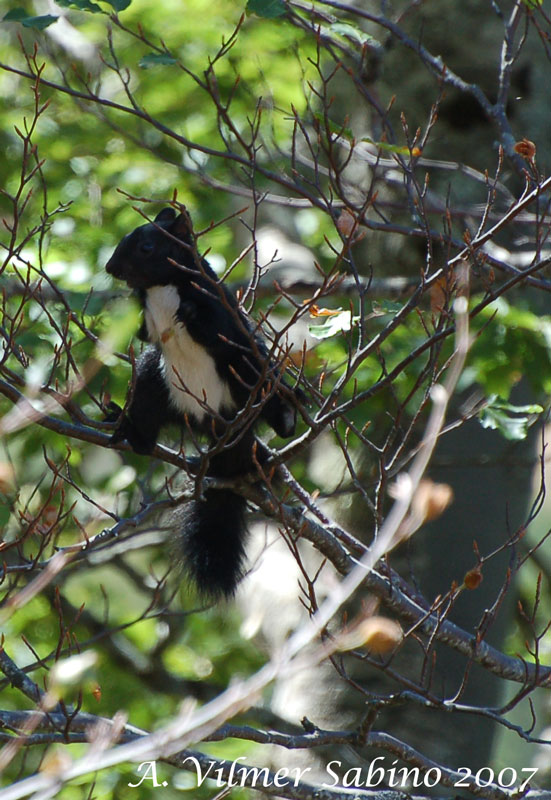
And interestingly, it wasn't just the little brown ones. If you go back to the post of two years ago, you'll see that I said that the "red" squirrels we'd seen at Eraclea were brown with a white belly. And they get darker as you get further south. They're all the same species but three different subspecies - Sciurus vulgaris fuscoater (which I think were the ones we saw) in the north; S.v italicus which are found in central Italy and S.v meridionalis, the black ones in the south.


But even within the subspecies there is a lot of variation of coat colour, and unlike before, this year there were both browns and reds all over the place.

When we're on holiday, my son and I play tennis every evening. Don't ask who wins, because I'm not going to go into that ... But anyway, at the end of the court, there's a hazelnut tree. And every time we played, the game was interrupted three or four times by a cry of Squirrel on court! by whoever was facing towards the tree. They'd run down the side of the court, zap up the tree, grab a nut, and then run back straight down the centre line.


We called them Brownie and Ginger, presuming it was the same pair each time - though who knows. And there were evenings when more squirrel photographing was done than tennis. But then, at my age, any excuse for a pause in a game is a good one...

They were one of the highlights of the holiday. And a very positive sign, as most reports say that the red squirrels in Italy are being threatened by the advance of the greys in the same way as happened in Britain. Nice to know that in one area at least, numbers are increasing.


The last day of the holidays came, we checked out of the hotel and walked up to the bus stop where we'd get the bus back to Venice in order to pick up our train. When we got there, I realised I'd made a mistake. I'd looked at the summer timetable, not realising that it had changed the day before we left, and the bus we thought we were going to catch was no longer running. We had about forty minutes to wait, so as we sat there we started playing I Spy to while away the time.


I'd just said R-S- (thinking Road Sign) when Anthony said Red Squirrel. And sure enough, there was a red squirrel rushing down a tree on one side of the road, scampering across and whizzing up a tree on the other side.

We watched him for a while, and then went on playing - until Anthony suddenly said RRS - Radioactive Red Squirrel. Even I didn't realise what had happened for a moment. The squirrel was in the middle of the road, lying on its back and twisting and squirming horrendously. For a couple of seconds I thought it was trying to rub its back against the asphalt - but then it was obvious - it had been hit by a car.

We hadn't seen the car - but the occasional car had passed and we hadn't really been looking. I would like to think that the driver hadn't seen the squirrel and hadn't realised what had happened. But I wonder ...


I ran over. The squirrel was in the middle of the road and if I'd left him there he'd have been squashed by the next car that passed. Perhaps it would have been the kindest thing, but I couldn't do it. I picked him up - gingerly, and holding firmly to the scruff of his neck with one hand, so he couldn't turn and bite.


But he wasn't even thinking of defending himself. He just lay cupped in my hands, not even seeming scared. He was a young male, and had the softest fur I've ever felt on any animal.

It was clear that he was paralysed from about half way down his spine, and I wanted to put him out of his misery. I put my fingers around his neck to try to break it. You'd think it would be easy, but believe me, it's not. His neck was so unexpectedly thick and solid that I was terrified of just torturing him further, and couldn't do it.


By now he could hardly move at all. He could still slightly wave his front paws, but the frantic twisting that we'd seen when he was in the road had gone. I laid him down in the shade of a tree, where he just lay still, his eyes slightly glazed over. But every few minutes he would suddenly draw in a deep breath and then let out a whimper which rent my heart.


Twenty minutes later, he was dead. I don't know how much he suffered. The paralysis, which seemed to have been progressive, should have meant that there was no pain. I hope so.

But I was numb all the way back to Milan. It wasn't just for his death - these things happen. But I have never felt so powerless, so out of control. We were in a tiny village where there was no vet. Even if I'd known where the nearest one was, we had no car to get there - and anyway, it was likely that I didn't have the time to do anything. I knew that I should have broken his neck there and then but couldn't do it. I felt so guilty.


I don't want it ever to happen again. I've even used Google to try and find out how to break an animal's neck, so I'll be prepared if it ever happens again. But I couldn't find anything that helped.

Sleep well, little squirrel. I hope by now you're scampering around in a heaven full of hazelnut trees, and have forgotten that last half hour. But I won't - ever.


Read more...

Dead Man's Lagoon

Thursday, September 17, 2009


Have you ever fallen in love with a place at first sight? It happened to me last week. After we'd gone back to Italy, my son and I went back to Eraclea Mare for a week at the sea. We'd been there last year and loved it (see here), but what we didn't realise was that we'd missed the best bit.


Eraclea Mare is situated not far from Venice, along the north west Adriatic coast. You probably know that Venice itself is built on a lagoon, but in fact lagoon areas extend much further up the coast. There is one, for instance at
Caorle, where we used to spend our holidays until we discoved Eraclea, made famous by Hemingway who used to go duck shooting there.


Eraclea's lagoon is different. It's smaller - only two square kilometers, is (thankfully) a nature reserve, and until 1935 didn't exist at all.


La Laguna del Mort (Dead Man's Lagoon) was formed when the River Piave, which used to run parallel to the sea for a couple of kilometers, overflowed its right bank, flooded the strip of land between the river and the sea, and changed course overnight, reaching the sea a couple of kilometers further up. The land between the old mouth of the river (pic above) and the new (below) became a lagoon.


Why didn't we explore it last year? Firstly because we had the rest of the area to get to know, and secondly because I was aching too much after a morning on horseback to contemplate the bike riding or walking necessary to get there. This year all the work in the garden in London must have made me fitter - I managed to do both.


From the village you can either cycle through the fields to the far end of the lagoon, or walk along the paths which lead through the sand dunes and pinewoods which border the wetland area. We did both, several times, and in later posts I'll blog about the plants and the wildlife we saw there. But for now, just enjoy the landscape.


Why the name? Not sure. If the net is to be believed there was once a corpse in the lagoon which every so often would rise to the surface to frighten passersby. Hmm - none of the local people seemed to have heard of that one. They appeared to think the "death" referred to the death of the river (though I've translated the name as Dead Man's Lagoon, a more literal translation would be The Lagoon of the Dead One, so it's not impossible). That seems strange though, as the river didn't actually disappear. I'm keeping an open mind.


We were there at the end of the season, and on a cloudy day. We had the place almost to ourselves. The beach however is well-known for being a naturist beach and (again if the net is to be believed) a rather steamy one at that. Oh well, the beach is separated from the lagoon itself by sand dunes and I guess it's big enough for both naturists and naturalists. I for one shall be going back.


Read more...

Balcony gardening ... or just exterior decorating?

Monday, September 1, 2008


What makes for a good balcony garden? Is it the variety of plants? How healthy they are? The visual impact?


Probably the answer is all of these. But it's difficult sometimes to score highly in all three categories at once. Playing safe and only choosing plants which you know will do well often means a balcony with just the old favourites - pelargoniums, surfinia and, here at least, plumbago. Creating visual impact often means restricting the plants to just one or two colours. Going for variety can mean that half your plants are experiments that don't work and end up looking tatty.


I'll cheerfully admit that my balcony definitely comes into the "variety at the expense of looking tatty" category, especially at the moment. It's the end of the season and even the plants which did well are looking as if they've had too much sun, fought off the pests for too long, and put out more blooms than they've got strength for. Those tell tale brown stems are starting to appear, and dead-heading no longer produces the same amount of flowers as it did a couple of months ago. And most of the experiments have just given up and died. Work on the balcony now consists chiefly of tidying up and pulling things out.


But while I was on holiday I came across some balconies whose owners had clearly gone for a different approach - visual impact at all costs. And some of them were stupendous, despite being incredibly simple and confining themselve to the old favourites. I loved the mass of pink ivy-leaved geraniums growing on the balcony in the top picture, and the strong colours of the ever-present surfinia too. And the salmon coloured zonal pelargoniums reminded me that my own, though they've been wonderful for several years, are now past their best. It's time to take cuttings and start again.


These begonias weren't quite so interesting, but better than the photo shows - as ever it's the problem of photographing red.


But my favourite was a balcony with no flowers at all - just leaves. A whole set of containers full of coleus, in an amazing variety shades and patterns. I've been meaning to grow some coleus for ages but not got around to it. Next year I certainly will.


For me these single-colour, single plant balconies aren't what gardening is all about. It's just exterior decorating - though I admit that the condition of the plants on these balconies showed that their owners certainly knew how to keep them healthy. But it's a get-plants-from-the-garden-centre-and-throw-them-away-at-the-end-of-the-season approach which would, as far as I'm concerned, take all the fun out of it.

So my balcony will probably never smack you in the eyes like these did. A pity, because I enjoy the visual impact of plants too. But it would mean giving up too much. I'll stick with looking tatty.


Read more...

Trumpet Vine

Saturday, August 30, 2008


I've always liked the look of the Trumpet Vine (Campsis radicans), also known as Bignonia. I know it can be invasive and can smother everything it gets its tendrils into - the photo below is of one growing up what once was a tree in the pine forest at Eraclea Mare, where we spent our holidays. It doesn't show up very well on the photo, but you can take my word for it that all you can see there is trumpet vine.


But on a balcony it's much easier to keep things under control. The plants are in containers so the roots can't spread, and the seeds mostly fall on the balcony floor - no real problems with self-seeding. I had been thinking that the plant would look great growing up the trellis at the far end for quite a while, so when I saw the one in the top photo growing at the side of the road, I wondered whether maybe a couple of the temptingly dangling seed pods could make their way into my pockets.

When I got closer though, I backed off - quick. Never have I seen so many wasps on a plant. There were hundreds of them, as well as a good collection of different type of bees. I'd heard that the plant attracted large numbers of insects, but hadn't quite imagined the scale of it.

I've noticed a number of posts on various blogs recently trying to convince us that "wasps are our friends" because they eat aphids, lay their eggs in caterpillars so that the larvae eat them from the inside out, etc.

Lay their eggs in caterpillars so that the larvae eat them from the inside out? Yuk - not what I want to see happening on my balcony every time I look at a plant. I may be obsessed with not killing things, but I wouldn't wish that on my worst enemy. Nor do I fancy having to shoo them out of the house every five minutes. We already get our fair share of huge ones, which I think are part of the sceliphron species (mud dauber wasps). My son calls them "the wasp with the trailer" because of the ridiculously long petiole which joins the two parts of their body. What evolutionary purpose that serves is beyond me. For once I tried to attract them today so I could take a photo, but despite leaving out fruit and jam there's been no sign. huh - I bet if I sat on the balcony to eat a peach ...

So I found this photo made available under Creative Commons license by Nigel Jones (thanks Nigel). It's not the same type - ours has a bright yellow body with black stripes and a straight black brittle-looking petiole. And they're much meaner looking. But you get the general idea.


So my trumpet vine plans have sadly been shelved. From now on I'll go on enjoying other people's but will leave having my own until the day I get a very large garden. And it will be going right down the bottom.

Read more...

Pinewoods

Monday, August 25, 2008


If you've commented on any of the last few posts and have been wondering why the comments hadn't been published - I've been on holiday. The posts were prepared in advance and went up automatically on the scheduled dates, but I've had no computer access for a couple of weeks so couldn't check for comments. They're all up now though.


We were at Eraclea Mare, a small seaside village on the north eastern coast of Italy, about 50 km east of Venice. A wide sandy beach gives way to sand dunes and pine forest, then the village which in winter has only 200 inhabitants, but in summer is full of tourists from Italy, Germany, Austria and Russia. The Brits and the French don't seem to have discovered it yet. From then on the land is flat until you get to the Dolomites - the eastern part of the Alps which divide Italy from Austria. They're about 100 km away, but on our last morning, after an incredible thunderstorm and hailstorm during the night, it seemed you could reach out and touch them, the air was so clear.


The crop growing in the field above is soya, one of the main agricultural products of the area. I went riding in the country one day and saw that they were experimenting with sowing soya and winter wheat at the same time. The winter wheat grows and is harvested before the soya really starts coming through, but once the wheat is gone it takes over. The advantage is that the field is only ploughed once, instead of twice, meaning less work but also less soil erosion and less air pollution from the tractors. The fields grown like that didn't seem to give nearly as great a yield as the one above, however, so I wonder if the experiment might be dropped. Does anyone know of anywhere else it's been tried?


I spent a lot of time walking and biking in the pine woods. I can't claim they were deserted, as they were constantly crossed by people going or coming back from the beach. But I managed to find some quiet shady paths.


The pines were Umbrella Pines (Pinus pinea) which are typical of Mediterranean regions. I was on the look out for wildlife, but there was disappointingly little. The most common birds were ring necked doves, which cooed and squawked in the trees around our hotel.


And there were also a far larger number of jays than I've ever seen in one place before. They were exceptionally tame, and would hop around on the ground in front of you, only flying away at the last minute - except of course on the day I went out with my camera to photograph them.


The only animal I saw was a red squirrel (Sciurus vulgaris) who was also a bit camera shy. I noticed him in roughly the same place on several occasions, but again, when I went out with my camera he refused to co-operate.


Red squirrels are still holding their own in many parts of Italy, though in some areas the greys are fast wiping them out. Despite their name, their coat colour can vary, including a variety found in the south of Italy (sciurus vulgaris meridionale) which is completely black. This one had a dark brown coat and the characteristic white belly.

Although I've been in the area many times before (my husband was born nearby and likes to go back to see relatives and old haunts), it was the first time we'd been to Eraclea Mare. I chose it because it seemed less developed and "touristy" than other places along the coast, and we were well rewarded. It was a super holiday and I know we shall go back. If you're in the area, I recommend it.


Explore some more...

For information on the danger posed to the red squirrel population by the greys : The European Squirrel Initiative

Read more...

  © Blogger templates Newspaper by Ourblogtemplates.com 2008

Back to TOP