Powered by Blogger.
Showing posts with label Birds and Wildlife. Show all posts

Starlings

Thursday, January 27, 2011


My mother loathed starlings (sturnus vulgaris). She'd always put out bread for the birds, but then spend hours chasing off the starlings. Bullies she called them, only interested in "stealing" food from the little sparrows. Anthromorphism rules, OK.

There no longer seem to be either sparrows or starlings in my Lonon garden. I've posted before about the sparrow decline in London (they're still going strong in Milan fortunately), but the lack of starlings is odd. Because they're still in the area - the car park of our local supermarket is full of them. The cars don't daunt them in the slightest...


Why have they abandoned our area of parkland and gardens to move into a trading estate? No idea. Wouldn't have thought that an Asda car park was that rich on pickings. Could be the MacDonald's next door I suppose ...

Oi Bert! Them kids 'ave just dropped a carton. Sling us over a chip, would yer...

But perhaps it's not just that. According to the BBC Wildlife website, the population of starlings has dropped by 92% on previous figures. That certainly tallies with what I've seen in the garden.

Starlings are sensible birds. Some migrate, some don't - it depends where they live and what the winter conditions are like there. Birds from eastern Europe, where temperatures are harsh, will migrate, either to milder climates like Britain (is that why I no longer notice them so much - because I'm only there in the summer when numbers are reduced to the residents?) or south, to the real warmth. Here in Italy we see huge flocks arriving every year. Both in Milan and Rome, the sky outside the main station is often dark with them, and the air shrill with the squawking of up to 100,000 individuals. I wanted to make a video of them this year but (of course) missed them and had to make do with a few photos. During a walk down the Martesana canal in November, I noticed that they were gathering. Numbers were puny in comparison to some flocks that I've seen, but still dangerous. I had to go home and wash my hair afterwards...


Yet even a few who live in more temperate climes will sometimes up and go.
The RSPB site says "These birds are residents, and most never leave us..." - which presumably means that some do. So how do they decide ?

- Eh Fred. Decided what yer doin' fer yer 'olidays?
- 'allo Charlie. Well, yer know, things 'ave bin a bit tight recently. Me 'n the missis thought we might just stay at 'ome 'n 'ave a few days out. You?
- Oh going down ter Majorca fer a coupla months with the gang. Yer know who I mean?

Those that decide to stay at home sometimes find themselves in trouble when unexpectedly hard weather comes. This one, with 25 cms of snow on the ground, was reduced to attacking the feeders for the tits on my sister-in-law's balcony in Northern Germany this Christmas.


So if you've got some in your area, take no notice of my mother's prejudices. They're no longer the common garden bird that they once were. Ignore the pompous, aggressive strutting and squawking, and focus on that gorgeous metallic sheen on the plumage. Losing the starling would be as great a loss as losing the Bengal Tiger in my opinion. So put out some food and don't chase them off. Even starlings have to eat...

Read more...

Look what they've done to my balcony...

Monday, January 3, 2011


As usual we spent the Christmas and New Year period in Germany. We left Italy just as a lot of European airports were being shut for snow, and thinking that it might turn south, I made sure to fill up the bird feeders before we left.


In fact, while most of the continent had a very white Christmas, Milan only had rain. That didn't deter the birds though. The great tits are clearly at the more respectable end of the bird community. They've been pecking their way gentilely through the peanuts,and I'm expecting a thank-you card to arrive soon. The sparrows, on the other hand, are a bunch of deliquents who clearly saw the bird-seed container as an invitation to vandalise the whole place.


The balcony looks as though a bomb has hit it, and I hate to think what I'm going to find growing in that container next year. On the plus side, I don't think I'm going to have to buy any fertiliser. By the time I've scraped up all the droppings, I'm going to have enough guano to last a couple of seasons...

In Germany, with all the snow that was around, the birds were virtually dependent on feeders and it was a great chance to spot a few types that we don't get here. Apart from the ubiquitous great tits and blue tits, I also saw some long-tailed tits, greenfinches and chaffinches, a nuthatch...


...and a tree-creeper.


Forgive the lousy photos - I had my camera on the wrong setting without noticing it.

There were various raptors around too. I saw a lot of buzzards in the woods, and a dead blackbird's head and mass of feathers in the snow on New Year's Day suggested we'd been visited by a sparrowhawk in the early morning.


Read more...

Death of a Squirrel

Sunday, September 26, 2010


We were back in Eraclea Mare on holiday this year, and one of the things I noticed was the exponential growth in the number of squirrels around. I posted two years ago about the little brown one I'd seen in the trees a couple of times, but last year I'd seen none. Then this year they were everywhere. The hotel owner confirmed that he too had never seen so many around.


And interestingly, it wasn't just the little brown ones. If you go back to the post of two years ago, you'll see that I said that the "red" squirrels we'd seen at Eraclea were brown with a white belly. And they get darker as you get further south. They're all the same species but three different subspecies - Sciurus vulgaris fuscoater (which I think were the ones we saw) in the north; S.v italicus which are found in central Italy and S.v meridionalis, the black ones in the south.


But even within the subspecies there is a lot of variation of coat colour, and unlike before, this year there were both browns and reds all over the place.

When we're on holiday, my son and I play tennis every evening. Don't ask who wins, because I'm not going to go into that ... But anyway, at the end of the court, there's a hazelnut tree. And every time we played, the game was interrupted three or four times by a cry of Squirrel on court! by whoever was facing towards the tree. They'd run down the side of the court, zap up the tree, grab a nut, and then run back straight down the centre line.


We called them Brownie and Ginger, presuming it was the same pair each time - though who knows. And there were evenings when more squirrel photographing was done than tennis. But then, at my age, any excuse for a pause in a game is a good one...

They were one of the highlights of the holiday. And a very positive sign, as most reports say that the red squirrels in Italy are being threatened by the advance of the greys in the same way as happened in Britain. Nice to know that in one area at least, numbers are increasing.


The last day of the holidays came, we checked out of the hotel and walked up to the bus stop where we'd get the bus back to Venice in order to pick up our train. When we got there, I realised I'd made a mistake. I'd looked at the summer timetable, not realising that it had changed the day before we left, and the bus we thought we were going to catch was no longer running. We had about forty minutes to wait, so as we sat there we started playing I Spy to while away the time.


I'd just said R-S- (thinking Road Sign) when Anthony said Red Squirrel. And sure enough, there was a red squirrel rushing down a tree on one side of the road, scampering across and whizzing up a tree on the other side.

We watched him for a while, and then went on playing - until Anthony suddenly said RRS - Radioactive Red Squirrel. Even I didn't realise what had happened for a moment. The squirrel was in the middle of the road, lying on its back and twisting and squirming horrendously. For a couple of seconds I thought it was trying to rub its back against the asphalt - but then it was obvious - it had been hit by a car.

We hadn't seen the car - but the occasional car had passed and we hadn't really been looking. I would like to think that the driver hadn't seen the squirrel and hadn't realised what had happened. But I wonder ...


I ran over. The squirrel was in the middle of the road and if I'd left him there he'd have been squashed by the next car that passed. Perhaps it would have been the kindest thing, but I couldn't do it. I picked him up - gingerly, and holding firmly to the scruff of his neck with one hand, so he couldn't turn and bite.


But he wasn't even thinking of defending himself. He just lay cupped in my hands, not even seeming scared. He was a young male, and had the softest fur I've ever felt on any animal.

It was clear that he was paralysed from about half way down his spine, and I wanted to put him out of his misery. I put my fingers around his neck to try to break it. You'd think it would be easy, but believe me, it's not. His neck was so unexpectedly thick and solid that I was terrified of just torturing him further, and couldn't do it.


By now he could hardly move at all. He could still slightly wave his front paws, but the frantic twisting that we'd seen when he was in the road had gone. I laid him down in the shade of a tree, where he just lay still, his eyes slightly glazed over. But every few minutes he would suddenly draw in a deep breath and then let out a whimper which rent my heart.


Twenty minutes later, he was dead. I don't know how much he suffered. The paralysis, which seemed to have been progressive, should have meant that there was no pain. I hope so.

But I was numb all the way back to Milan. It wasn't just for his death - these things happen. But I have never felt so powerless, so out of control. We were in a tiny village where there was no vet. Even if I'd known where the nearest one was, we had no car to get there - and anyway, it was likely that I didn't have the time to do anything. I knew that I should have broken his neck there and then but couldn't do it. I felt so guilty.


I don't want it ever to happen again. I've even used Google to try and find out how to break an animal's neck, so I'll be prepared if it ever happens again. But I couldn't find anything that helped.

Sleep well, little squirrel. I hope by now you're scampering around in a heaven full of hazelnut trees, and have forgotten that last half hour. But I won't - ever.


Read more...

Coypu

Monday, August 30, 2010


Now that the summer is showing signs of waning and the city is cooling down, I've been venturing out again occasionally for a walk. We were walking along the Martesana canal (1) last week, and talking about the ducks and moorhens, which seem to be more plentiful than usual this year, when someone said to us : Excuse me but do you know what that animal over there is?


Animal? On the Martesana? Apart from the occasional infestation of rats which the Council soon steps in to deal with, I've never seen any sign of wildlife on the canal. But yes, there they were - two little Coypu (2) happily going about their business on the far bank.

The coypu (Myocastor coypus)is widespread in Europe. A relative of the beaver, they're originally native to S. America, but are bred for their fur (and sometimes their meat, which is very low in cholesterol). Animals which have escaped from the fur farms have gradually colonised the continent. They are usually considered a pest - here in the north of Italy for the damage they do to the rice crops (Lombardy is the most important rice producing area in Europe) - but elsewhere for a range of reasons ranging from the destruction of other crops such as sugar beet, to the damage their burrow do to river banks, to the threat they pose to other species because of their impact on the environment (3).

But I'd never seen them, or even heard of them, in Milan. And I'd never noticed them on the Martesana before. True, I'd not been there very much for a couple of years - the canal path was closed while they built a new railway bridge for the high speed lines and, as always what was meant to take a matter of months went on .. and on... and on.


A quick bit of research on the net solved the mystery. It's all the fault of the recession.

When the recession hit, people stopped buying fur coats (at least one positive result, then). And rather than pay to have the animals put down, the fur farms often just released them. A few found their way to the Martesana and the population has been steadily increasing ever since.

And wow, has it been increasing. From nothing two years ago, the canal is now overrun by them. We didn't notice that day, but as I didn't have my camera with me (you never do when you want it, do you?) we went back the next day to try and get some pictures. Not that I had much hope - I was convinced that they'd have disappeared.


No way - as we walked down the canal, I estimate that we saw a pair every three or four hundred yards - and we walked for about two hours. I was amazed at just how quickly they'd established themselves.

So there you go - my London garden has its urban foxes, and here in Milan I've got coypu in the back yard. Almost like living in the country.

References

1.
The Martesana Canal
2.
Coypu
3.
Global Invasive Species Database


Read more...

Feeding the Foxes

Thursday, August 26, 2010


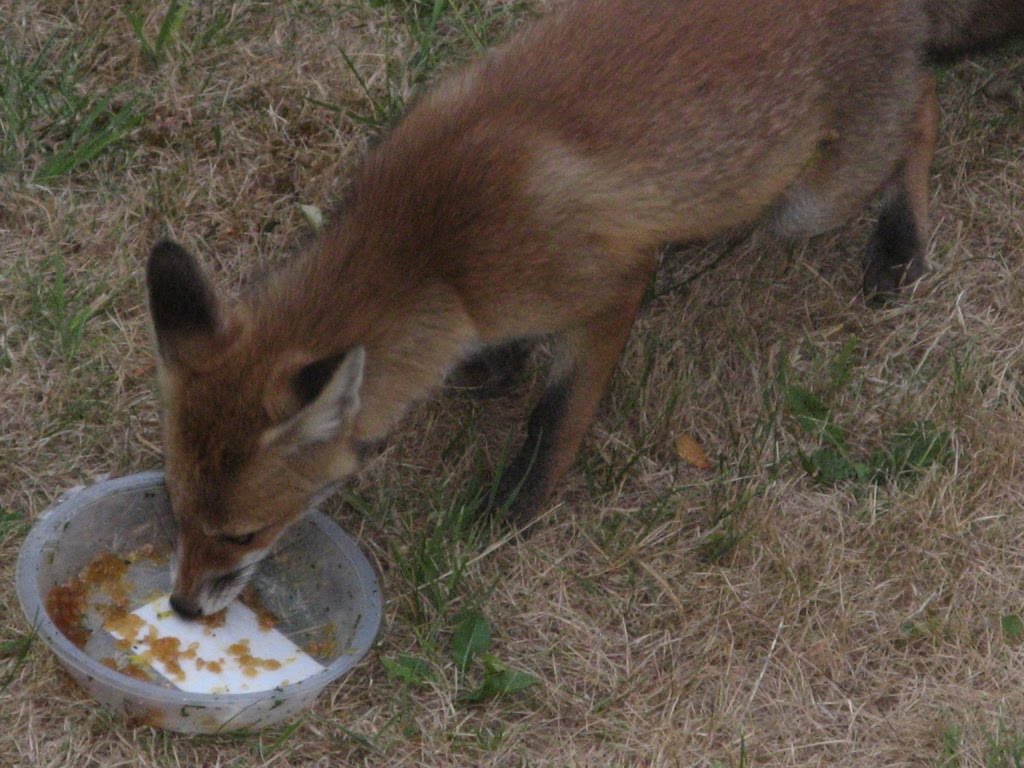
I hadn't been home in London for ten minutes last month when one of the local foxes came to visit. I'd gone out to see how the garden was and we came face to face as I turned around the hebe bush. He ran off about twenty yards to the compost heap, and then looked back over his shoulder with a look that quite clearly said What are YOU doing in MY garden? before disappearing into the park behind the house.

He looked a bit scraggy, and so for the ten days that I was there I put some dog food out each evening at about the same time.

I've blogged before about
whether it's a good idea to feed urban foxes, and I think if I was there permanently my answer would be no. Not regularly anyway. However, when I'm visiting I admit that I can't resist the temptation of watching them every evening.

Not that it's that easy to feed foxes. In fact, you have to be prepared for quite a challenge. The first bit's easy - you just wait till evening, plonk the food down and go inside to wait at the bedroom window, where you can see but not be seen, camera at the ready. And then the fun starts...


First you have to chase off all the neighbourhood cats and convince them that they really don't want to eat your scraps, or dog food, or whatever it is you've put out that evening, and that there's bound to be something much nicer waiting for them at home. By the time you've done that, you've run downstairs to the garden at least five times. But getting rid of them just means the coast is now clear for the heavy mob to move in...


And before long word has got round the whole neighbourhood that there's a party on. Gatecrashers arrive from all directions...


However, finally, the dog fox arrives. He eats precisely half of what's there and then leaves, peeing on your roses as he goes (gee thanks). Sainsbury's dog food not good enough for him?


No - he's just left half for the vixen, who arrives ten minutes later. How do I know it's not just the dog fox just come back? Look at the tails. And how do I know which is the dog fox and which the vixen? I told you - the dog fox pees on the roses...


And who's this? One of the young maybe? Seems in considerably better form than his father - look at that nice glossy coat. Though, in fact, all of them look much healthier than in previous years. Perhaps I'm not the only one in the neighbourhood who invests in Sainsbury's dog food when they haven't got a dog ...


Read more...

Heron

Monday, July 26, 2010


It has been so hot here. Daytime temperatures have been up in the high 30°s C (97°F+), with humidity at around 50% plus. One night at 3.30am when I couldn't sleep, I checked and the temperature in the house was 31°C (88°F) and the humidity had reached 86%. Plants have been wilting fast, and so have people. We daren't open the windows at night because of the mosquitoes (including tiger mosquitoes) and so fans and air-conditioning have placed such a strain on the electricity supply, that blackouts have been frequent.

The only time that it has been possible to consider doing anything active has been around dawn (anti-mosquito lotion having been applied.) So just as it got light one day last week, Anthony and I grabbed the bikes and headed for the Parco Nord.

We weren't the only ones with the same idea - joggers, dog-walkers and other cyclists were out in force, despite the time of day. But not enough to frighten off the wildlife, which was also taking advantage of the few hours respite from the heat. We headed for the ponds, where we saw moorhens, turtles, shoals of fish, swallows and this grey heron.

We got quite close, and he didn't seem too fazed. But then he must have decided that enough was enough, and took off ...


Lombardy has two types of heron - the large Grey Heron that we saw, and the Little Egret - a smaller type, completely white in colour. Both types are fairly common in Europe (as well as Africa and Asia), but because Lombardy is an important rice growing region (the largest in Europe), they are particularly common here. They hunt in shallow water and, whether near rivers, canals, ponds,or flooded rice fields, both types are fairly easy to spot wading through the water in search of the frogs and fish that are their main prey.

I don't think I've ever seen one quite so close up though.


Read more...

Spiders

Wednesday, June 30, 2010


If you are an arachnophobe - that is, if you suffer from fear of spiders - DON'T SCROLL DOWN. There are photos that you might not like.

But then, I guess that the average gardener can't be too worried. You can't move a leaf without seeing them, especially at certain times of the year.

I have to say I love them. OK, place one of the really poisonous types on my hand and I might freeze. But for the danger, not because it's a spider. In our house, the yell,of "Call Mum - there's a spider in the bath" occurs frequently.

All right - you've been warned, and I hope there's enough text for the photos not to appear above the fold, so that anyone who hates them will have disappeared by now. But just in case we'll start with the least spidery.

What, I wondered when I was at home in England, were these little yellow balls sitting in my front garden hedge. To the naked eye they just looked like blobs. It wasn't difficult to guess though, and when I blew the photo up - baby spiders!


Whose babies, I wondered. I didn't notice any adult golden-black striped spiders in the garden, but I looked them up and Araneus diadematus seems to match. According to my book on British wildlife, it's supposed to be the most common British garden spider, so I'll go for that.

Not sure about this slightly out of focus but hugely pregnant lady. I know how she feels - I was once hugely pregnant in the June heat too. But haven't been able to identify her so far - ??


By far the most common type of spider in the garden seemed to be a small one with a green abdomen and dark legs. Possibly
Araniella cucurbitina ?? But the legs seemed darker. They never stuck around long enough for me to take a photo. How many spiders are there in Britain, I wonder? Or in Italy ? I rarely seem to see them here in the city. And in the whole world?

The last type I saw was, potentially, much more scary. This is what my mother used to call a cob - though what the difference between cobs and spiders is (if there is any), I don't know. And I've not found a really similar picture. But she just sat there at the base of the compost heap while I rushed in to get my camera. So I doubt if she had any really evil intentions ...


Read more...

Skywatch Friday : Buzzard

Thursday, September 24, 2009


While we were at Eraclea Mare, we went on a lot of long bike rides - through the fields, around the lagoon, and along the river path. On one of them I spotted a buzzard (buteo buteo) circling far overhead. It was a perfect day : bright blue skies with patches of fluffy cloud, and as he circled he passed from one to the other.


Buzzards are now common throughout Europe and also in various areas of Asia - there are estimated to be over 4m of them. Yet I don't think I'd ever seen a buzzard until a few years ago, when I started to notice them in North Germany. We go there each year for Christmas, and in the winter, when the trees are bare, they can often be seen as you drive down the motorways, perched on tree branches. But seen like that they're small, fleeting silhouettes. You can recognise them by their shape - the plump body and stubby tail (it is when they're perched) are giveaways - but there's no great satisfaction involved.


This time it was different. Despite the height at which the bird was flying, with the aid of my camera zoom it felt almost touchable. Definitely one of the highlights of the holiday.


Check out the other Skywatch Friday posts here. I had to wait a while this evening to find one worth recommending - but I did enjoy this one from Finland.


Read more...

Squirrel

Sunday, August 9, 2009


My garden in London backs on to a park which is maintained as a wildlife sanctuary, and much of the wildlife finds its way across the back fence into the garden - especially when it knows that there's food on offer. One of the most frequent visitors is a little grey squirrel.

Grey squirrels aren't native to Britain. They were first introduced in 1876, from America. But they bred rapidly and soon took over from the native red squirrels, once widespread. There are now estimated to be about 2.5 million greys as opposed to only 120,00 - 160,000 reds, which are mostly found in the coniferous forests of Scotland.

Why has the red squirrel declined so dramatically in numbers? Destruction of the woodlands which are the red squirrel's natural habitat is one reason. The grey squirrel has a number of advantages when competing for food. It can eat acorns, which the red squirrel can't, and which are often now the main food source in the parks and woodlands where the greys are found (I just wish they'd remember where they bury them - you can't imagine how many sapling oaks I pull out of my garden each time I'm here.) In addition, where hazel nuts (a principal food source for the reds) are growing, the greys have the advantage of being able to eat them when they are still unripe - which the reds can't. The greys therefore get there first, leaving fewer for the reds.


But one of the main reasons for the drop in numbers seems to have been a virus called the parapox virus. The greys are unaffected by it, but evidence suggests that they can and do carry and spread it. And for the reds, it's deadly.


It's estimated that red squirrels will disappear from and area within 15 years of the introduction of the greys and they are now a protected species, with projects to reintroduce them to their natural habitats being carried out in various places. One highly successful case was in Anglesey in North Wales, where culling the greys resulted in the re-establishment of a thriving population of reds.


The greys, on the other hand, are seen as vermin and can be legally killed. Local DIY shops and gardening centres here are full of squirrel traps. You do need the permission of the landowner to set them however, so if any of my future tenants are reading this - you don't have it. If there is any control to be done, I feel it should be done in a planned way by the authorities, not by individuals. And in fact research is apparently being done to find an oral contraceptive which can be left where the greys will eat it but not other animals. Squirrels on the pill - the mind boggles. But a far more acceptable solution to my mind than people taking the problem into their own hands.


I like the squirrels though and wouldn't want to lose them from my garden. Yes, they can be a nuisance. They raid the bird feeders and the fruit trees, dig holes in the garden to bury their nuts and acorns, and dig up and eat the flower bulbs. (Yikes, I bought 200 daffodil bulbs to plant in the garden the other day - that should keep ours going for a couple of weeks.) And more seriously, they will eat birds eggs and baby birds. But they're fun to watch and brighten up the garden considerably. And they provide interest for our neighbours' cat, who is convinced that one of these days he'll be quick enough to catch one. Not a hope in hell. They just leap across the garden, whizz up a tree and sit at laugh at him. I swear I saw one throwing a nut down at him the other day ...


Sources

National Geographic News
UK Biodiversity Action Plan
London Evening Standard
The Friends of the Anglesey Red Squirrels


Read more...

Birds on the Balcony - Finally

Saturday, June 27, 2009


It's taken years, but I've finally managed to convince a couple of birds that they will not be eaten alive if they come onto the balcony.


OK, it's only the odd common-as-muck Great Tit - I can't offer you anything exotic. But I'm proud as punch.


I've had a feeder up since January, but it hadn't been touched and I was about to throw it away. And then when I went onto the balcony one day last week, two tits suddenly flew off.

But if they weren't afraid to come onto the balcony, why weren't they touching the nuts?

Probably, I thought, because by now they were stale. So I replaced them - and within twenty four hours - bingo. I had birds feeding on the balcony for the first time.


I think it's just one pair that come. They turn up at exactly 8am for breakfast every morning. The female is more wary - if she sees me she's gone for good. But the male is more confident. He just waits a minute till I've gone and then flies back. He didn't spot me this morning. I was in the bedroom hiding behind the bed with the French doors wide open, camera at the ready ...

Hope he enjoyed his breakfast.


Read more...

Birdsong

Friday, June 12, 2009


The gardens surrounding the flat have seen a population explosion in the last few months. Of blackbirds. We've always had a pair living here, but this year there must be at least four. And now that their babies are out of the nest, we're almost trampling them underfoot every time we go out. Not your shy, retiring types these. They were on the path first? Well don't expect them to move. You just have to walk round them.

Strange to see so many, because blackbirds are territorial. According to the
RSPB website they will cope with as little as 0.2 hectares of territory. But (if my maths is correct) that's 2,000 square meters. Here, they're living on top of each other. They certainly all stick to their own patch, but it can't be more than about 1000-1500 square metres per pair. (Apologies to anyone who read an earlier version of this, where my maths was way out. I'm useless with figures.)

How do I know? Because they sing to me all day long. Blackbird song must be amongst the most beautiful there is, and this year it's kept me company all day every day. By chance I came across this article on the
BBC website the other day reporting on how Great tits in the city sing more loudly than their country counterparts - to make themselves heard over the noise, the article said. Well my blackbirds seem to be doing the same - but I wonder if it doesn't also have something to do with the overcrowding. They sit in "their" trees and scream at each other from 4am onwards.


And over the past few months I've started to recognise the differences in their songs. So, come and meet Pippin and Squeaker....

Pippin has his territory in the front garden. I can hear him from the flat, but his main patch is in a tree just outside my office. Now that the weather is warm and summery, I generally leave the French doors open and he sings to me as I work. He's at it now, as I write in fact. He's an incredibly respectable blackbird. Black and glossy and with a song like liquid gold.

And then there's Squeaker. That's him in the photos. Oh dear, quite a different kettle of fish. Dead tatty to look at, and in the song department - well, let's just say he's somewhat challenged.

Not that his song doesn't have it's own beauty. But it is - how should I say it - somewhat repetitive. And after a couple of months of Flirtpety flip flop! Da da DO dee dah sixteen hours a day, I would quite happily pay for him to have singing lessons. Especially as "his" tree is just outside my bedroom window. I've been awake just after dawn every day for the last two months.

Listen and decide for yourself. The video lasts about a minute, starts with Pippin and then goes on to Squeaker. If you're in the UK or somewhere else in Europe, don't be surprised if it doesn't sound quite like the blackbirds you're used to - like people, birds have regional "accents". British blackbirds, French, German and Italian ones etc won't sound quite the same. And if you live outside Europe and have never heard a blackbird - well, enjoy ...


Read more...

  © Blogger templates Newspaper by Ourblogtemplates.com 2008

Back to TOP