Powered by Blogger.

Greens are great

Thursday, September 6, 2007

I finally sowed some seeds of fall greens in flats and in the ground on Monday. I was a bit late for timing of some of the larger fall vegetables (the ones that take longer to mature) but I'll be able to harvest the fast-growing lettuces and baby mustards within the month, and hopefully get a cut-and-come-again second harvest. Cilantro and argula are also two fast-growing and tasty greens. Transplanting red cabbage seedlings and attractive kales from the garden center are another way to get a quick start on a fall greens garden.

If the first frost doesn't come too early, I'll almost certainly be able to harvest the hardier kales, collards, mustards, and (slightly-protected) spinach through late fall, and again in spring. Here's a container of young spinaches that overwintered last year and provided some tasty early spring salads.

Brassicas -- the mustard greens of various sorts -- grow incredibly fast, and with luck will provide some excellent fall and winter greens. Red mustards are so pretty that it's hard to harvest them sometimes -- I try to grow enough for eating and appearance!

The kales and collards are remarkably resistant to hard freezes, and some people think the flavor is improved after frost. I like to grow more tender-leaved kales than the traditional curly varieties, so I haven't noticed this so much.

Read more...

Wildlife in the Garden


I came across two mysteries in my London garden. This was the first...

How did my garden get to be full of egg shells?


OK. I have to admit that I partially know the answer to this one. Foxes. My garden backs on to a park which has a children's zoo containing a lot of animals - rabbits, goats, sheep, pigs, deer, ponies and so on - and also poultry of various sorts : chickens, ducks, guinea fowl and peacocks. It's also a wildlife reserve - and full of foxes. The foxes steal the eggs and bring them into my garden to eat. I frequently dig up old bones, or find the remains of dead pigeons lying around, too. The mystery is not so much who brings the eggs in, but how do the get them in the first place? Since a memorable chicken massacre which occurred many years ago, the enclosures have been made fox-proof. The fact that there are still chickens and so on around shows that they can't get in. So how do they get to the eggs? But year after year, wherever there's an overgrown patch of garden, I'll find white chicken egg shells.

We hear the foxes in the garden almost every night, and I used to spend a lot of time watching for them. But this year, it wasn't necessary to stay up - we frequently saw them in broad daylight. I think they were used to the garden being unused and abandoned. A big dog fox which I found doing something unmentionable in my newly-dug side bed was very startled when he saw me - and obviously couldn't quite decide whether to run for it immediately or finish what he was doing first. Of course, I didn't have my camera with me ...

The other mystery was - whatever were these odd-shaped tuber things? I must have dug up over a hundred of them, and couldn't work out what they were. Then after a couple of weeks I found this ...


and realised they were there for the same reason I had an oak tree growing in my rose bed ....

Squirrels. Burying their peanuts and acorns in my garden and then forgetting all about them. That does however leave another mystery? Why isn't my garden as full of peanut plants as it is of young oak trees?


Read more...

Kale, chard, spinach, and lettuce

Wednesday, September 5, 2007

When we first moved to the south over 20 years ago, I had never eaten kale, collards, mustard greens, or turnip greens. I don't recall eating much spinach either, as a child, since it was largely available as the canned sort. And my mom was a decent, but relatively uninspired plain cook, from a farm cooking background. Although I grew up eating broccoli and green beans (frozen), my education with vegetables and fruits started in the SF Bay Area markets during my graduate school years. I first had fresh brussel sprouts (good), fresh mushrooms (delicious), fresh local Gravenstein apples (great), peaches, apricots, and plums straight from the Central Valley (fabulous), and learned about so many unusual vegetables in the Chinese and other ethnic restaurants that were springing up in the late 70's and early 80's in the melting pot that was the SF Bay Area even then.

But moving to SE Georgia in the mid 80's was interesting in a different way. Southern cooking with its greens, fried fish, and biscuits and gravy were a long way from the plain cooking of my youth or the Schezuan restaurants in Chinatown. A new, older colleague who was a keen organic vegetable gardener was amazed when I said I had never eaten kale, or turnips, or collards. I quickly learned to appreciate the greens at a local restaurant, where the fried whiting was a Friday night standard. A bit salty, by today's tastes, but delicious with a bit of Texas Pete.

Today, I stir-fry homegrown greens of all sorts with olive oil and garlic, and we thoroughly enjoy them. And I've grown all sorts of 'ethnic' greens from the Tuscan kale, to Russian kale, to Asian mizuna, to the pac choi. All delicious! The high-end Italian dandelion greens were more bitter than I expected, requiring par-boiling, but hopefully quite the spring tonic. And hopefully the radicchio (that was such a favorite of our nursing female squirrel) falls into that category as well.

Read more...

The Garden Bloggers' Dream Team

Monday, September 3, 2007


It must have been one of the days early on in the holiday, when it was hot and sunny. And there was I in the middle of the garden, in full sun, digging out the borage in the rose beds. And panicking because I had so much to do before I went back to Italy. And as I sweatily dug and pulled roots, I started to think how nice it would be to have some help. And the idea of the Garden Bloggers' Dream Team was born.

Who would be your dream team? I picked on :

Sue (the other one) to be responsible for garden design and the selection of plants.

John to take care of the vegetable garden, with special responsibility for potatoes.

Hannah to look after the tomatoes.

Carol to do the hoeing.


Sarah
to grow the sweet peas.

Jane to keep us organic.

Anthony to make the compost.

and Snappy to take the photos.


Who else? I really need someone to sort out the lawns and the roses and a hundred and one other jobs ... Any volunteers or nominations? Or would you have a completely different Dream Team?

Read more...

Hummingbirds are everywhere

Sunday, September 2, 2007

We've had fun watching the hummingbirds whizzing around the garden lately. Right now, it seems that we have five. An adult male, 3 females, and a juvenile male. The adult male has just arrived, probably passing through on his way south, but the others have been here for a while. The females chase each other around, but fairly companionably, and they seem to be friendly with the juvenile male. Yesterday, it almost looked like one of the females was the 'mom' and the juvenile male (he only has a few red feathers on his throat) was wanting her to feed him. We have two feeders near the porch, where we eat during nice weather (basically April to October), with an additional feeder on the other side of the house. But there are also the nectar-rich flowers of the Salvias (S. guaranitica and S. coccinea) and the coral honeysuckle (Lonicera sempervirens) and the Buddleja flowers for nectar. There are lots of insects, too, in our garden.

My gardening partner has been busy this weekend moving mulch --lots of freshly chipped trees from our campus that the tree service fellows were happy to give us (we gave them a nice 'tip'). He's moved one truckload already, to nourish the front woodland garden. The second two loads will add mulch to the back garden, and other areas. Organic matter is solid gold to add to your garden.

The lovely hummingbird image is from Early Birds: Common Backyard Birds by Millie Miller and Cyndi Johnson, Johnson Books, Boulder, CO.

Read more...

Survivors

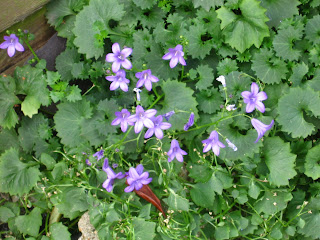
Not everything in the garden was a complete disaster. Some things had managed to survive despite the neglect they've had to undergo, like these little campanula which were growing out of a crack in the path ...


and these roses, struggling desperately to emerge from a bed overgrown with grass and weeds.


Some of the shrubs were thriving, like this fuchsia by the front gate ...


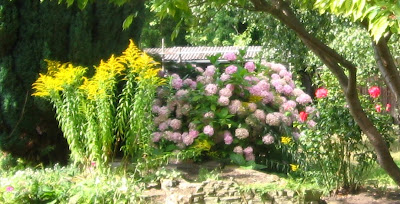
and the hydrangea in the back garden. I've never tested the soil in the garden but it must be acidic. Hydrangeas always do well, and in the past we've had a lot of success with azaleas too. This particular plant must be about thirty years old by now, as is the fuchsia.


I love fuschias and planted this one about ten years ago in a raised bed by the back door. It was doing very well at one point, but now seems to have been crowded out by some self seeded Golden Rod.


This hebe comes from a cutting I put in about four years ago to fill an empty bed. Since then it seems to have exploded. It was past its best by the time I got home, but was still a big draw for butterflies. Needless to say I never had my camera with me at the right time ...


The crab apple bush had a good crop of fruit this year ...


and the weigela and the hibiscus were still surviving. The weigela flowers earlier in the summer, so I missed most of the flowers. The hibiscus was a bit sad - there were plenty of buds, but they were falling before they opened. Unfortunately I didn't have the means or the time to find out why or do anything about it. The tree looked perfectly healthy , so I'm hoping it was just something about this year's weather conditions. I'll check before I go back next time.


Read more...

Borage

Saturday, September 1, 2007


Borage. The very name has me shaking with fear. My garden in London is overrun with the stuff, and it's all my fault. I planted it about fifteen years ago, because I thought the flowers were pretty - but before I knew how invasive it was. It self seeds like crazy. And it has long thick taproots which, in an established plant can go down for two feet or more, making digging it out extremely hard work.

Had I been living there, it would have been no problem - I could have kept it under control. But ten years of non-gardening tenants means that it's just been allowed to run riot. By the end of the month I was digging it up in my dreams, as well as all day. Luckily the seeds germinate quickly, so by about a week after I'd cleared each area, I was able to go back and get the next generation. but I know there's no way I could have got them all, and next summer the garden will be back to square one ...

I came back relieved that at least I wouldn't have to think about borage any more. But I hadn't turned my calendar over before I left, and when I did ....


At least I've only had to put up with it for a couple of days. But it shows that borage can be pretty when it's planted in the right place and kept under control. I love the combination of plants in this picture. It can also be very useful in the garden. Firstly, because it attracts bees - and in fact, my garden was full of them. And also as a companion plant. It is supposed to stimulate the growth of strawberries, and act as a deterrent to tomato worm. It attracts blackfly, and can therefore be used as a sacrificial plant to attract them away from other things in the garden.

Borage is edible, although the leaves do contain a liver-toxic chemical, so don't exaggerate. The flowers, on the other hand, are perfectly safe. The leaves are often added to salads, and to soups and stews during the last few minutes of cooking. They're also used in drinks like Pimms. The flowers can be frozen into ice cubes and added to any gin-based drinks, or used to decorate desserts - they have a sweet, honey-like taste. You can find a selection of borage recipes
here.

Borage is also used medicinally in the form of infusions, creams and oil. It contains gamma linoleic acid (GLA), an omega-6 polyunsaturated fatty acid, and has a whole range of uses from alleviating the symptoms of skin complaints such as exzema and psioriasis, to combatting pre-menstrual syndrome, to the treatment of certain
cancers.

Traditionally, borage is associated with courage. Celtic warriors drank borage wine and painted their bodies with it before going into battle. it is thought to stimulate the adrenalin glands, producing adrenalin which helps the body deal with stressful situations. I can believe it. Over the last four weeks, my adrenalin levels have been sky high just looking at the stuff ....

Read more...

  © Blogger templates Newspaper by Ourblogtemplates.com 2008

Back to TOP