Powered by Blogger.
Showing posts with label water conservation. Show all posts

Woo, hoo! More rain!

Monday, September 27, 2010

It's ungrateful not to be glad for the inch and a half or so of rain we've already received, but... we're glad to have an evening wave of thunderstorms and heavy downpours add to the total.

We came out of drought conditions officially last January after years of significant, if not severe drought, but went back into incipient drought (according to our state climatologist) in mid-summer, I think.

October is normally a dry month, and in a newspaper article today, she (our state climatologist) is predicting a dry fall and winter because of La Nina effects.  So anything helps at this point.

I'm beginning to think about focusing more sharply in my educational gardening programs towards sustainable gardening.  I've already been doing that, but really, we don't have any justification as gardeners to use landscape plants that need more water than we've ever normally received in rainfall.  And in a time of a changing climate, it's best to be more conservative than ever in how much 'life support' our garden plants need.  I don't see how we can justify watering lawns and landscape plants, when folks downstream need water for drinking and other essential uses.

Sure, our vegetables are water and nutrient-hogs, but that's to be expected.  We've bred them for productivity, not for their thrifty character. 

But we can go a long way with mulch, soil conservation techniques, and conservation of rainwater and gray water.

Read more...

High-Tech Toilets of the Future: Conservation of Water

Tuesday, August 3, 2010

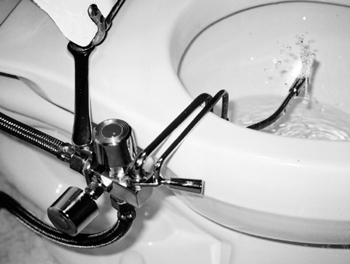
Of all the things going high tech, this is the most unexpected. Yes, after everything, its your toilet this time. High tech toilets are the all new big thing, about to hit the markets sometime soon. The high tech toilets from Japan are already creating waves, their modern age, sensor features. The high tech toilets of the future are bathroom fittings on the same lines.

Some of the features that are operational right now in the Japanese high tech toilets are as creative as the toilet lid lifting itself up as and when a person approaches it and deciphering whether to stay up or be down. It is fully adjustable, lets one decide the angle of the jet, the temperature of the water, releasing a deodorant to keep away put off the smell. A completely adjustable toilet seat allows a comfortable sitting position for old people and arthritis patients. No toilet paper is required in these high tech future models and an automatic drying follows after the wash.
But of all the other features of the high tech toilets of the future , the most important one that has not been mentioned till now is a design that allows water conservation. Conserving water is one of the most important environment needs at hand right now. The modern engineered designs are coming up with toilet flushing systems that are low consumption toilet models. They have options for choosing the amount of water that needs to be flushing, sometimes even deciphering themselves how much water to use and how much of pressure. Japan has been one of the leading countries in introducing these spectacular models of outstanding engineering. They are not just examples of beautiful creations in bathroom fitting designs but the high ability flushing systems are also a huge help in conserving water and saving the environment.

View an interesting photo gallery on Modern Wall Hung Flushing System Designs.

Read more...

Waterwise gardening

Sunday, August 31, 2008

All the rain last week (hooray for that) meant lots less time outdoors (since it was pouring) and in the garden (actually being back at work is the main reason). But shifting from home garden thinking to work garden ideas isn't too much of a contrast -- it all blends together in how I think about plants, gardening, ecology, environmentally-friendly approaches to gardening, and observing and learning more about nature.

I've been thinking quite a bit this week about sustainable gardening, and what waterwise gardening in our climate really means. Talking this week with my colleagues about updates for our xeriscape garden has me mulling over my approach to sustainable gardening.

I guess because my first interest in plants was those living in 'wild' landscapes that were native to the Texas Hill Country where I grew up, followed by a fascination with weedy species from a summer spent with my family in upstate NY (and visiting frequently in NYC) as a young teenager, and fortified by the tremendous plant diversity in California, where I studied plant ecology as a graduate student, I'm looking at our home landscape/garden with an ecologist's eye to plant behavior and needs.

The standard (US) horticultural recommendation of an inch of water a week sort of seems nuts to me. Is this a lawn thing? My pampered vegetable garden, well, yes, maybe, but our trees, shrubs and perennials (mostly native or tough) will happily get by on a lot less water. Uh, what about all the plants out there in the 'wild'? No one's watering them.

And we certainly DON'T need an irrigation system to successfully garden, even in times of drought.

I think being a waterwise gardener means choosing plants that can withstand dry spells, and flourish without lots of supplemental water (I wrote this in a post last September and this in October). Here in the SE (United States), we can grow lots of great plants that fit that description. Many of our native plants are prized in Europe as normal landscape plants, so this doesn't mean our palette is restricted to cacti and succulents.

Beth Chatto's gravel garden in East Anglia, England (20 inches of rain/yr)

She uses lots of Mediterranean natives in this garden.

Long hot summer dry spells (3-4 weeks) are not uncommon here in the Southeast, so native plants exposed to these conditions (those that don't live along streams,rivers, in floodplains, or in the mountains) have various adaptive strategies to cope, either through different types of tolerance mechanisms or avoidance (by being dormant). Clues to drought-tolerance come from native habitat (grasslands, prairies, dry woods, shallow soils, rocky slopes, etc.), plant habit (deep tap roots or fibrous storage roots), leaf color and texture (gray leaves are reflective, waxy or thick leaves are water-loss resistant).

What really gets me cranky is our American/Southern focus on lawns. In our home garden, we have perfectly nice areas of Zoysia lawn, established many years ago, and greatly diminished in size since we moved in. They never get a bit of supplemental water from us, nor any fertilization, aeration, de-thatching or anything else resembling 'lawn care.' The clippings are left to decompose and renourish the lawn. The lawn patches that are most exposed to sun and on shallower soils have suffered during the drought, turning totally brown. But the rain last week has stimulated regrowth of tender young shoots, so maybe that area isn't ready to be turned into raised beds after all. Darn!

Read more...

Rain

Sunday, February 17, 2008

We need all the rain we can get in the Southeast. It's been raining tonight, and this winter, more in some places than others. The Greenville paper reports that we're still behind by a third of normal for this year for the area that they monitor. The local ponds have filled up but the larger lakes (which serve as local water reservoirs, in addition to their recreational uses, and power plant support) have tremendously large blank areas along their edges.

The long-term forecast from NOAA suggests that the drought will ease here this spring. I hope so. But I'm also hoping that the winter respite from the evaporative stress of summer and fall won't lull us into thinking the drought is over.

I heard a public service message last week (on a Charlotte, NC station) with the Governor of North Carolina reminding listeners to conserve water, as the drought was still severe.

Read more...

  © Blogger templates Newspaper by Ourblogtemplates.com 2008

Back to TOP