Powered by Blogger.
Showing posts with label Pests and Diseases. Show all posts

Sacrificial Mint??

Sunday, October 10, 2010


If there's one thing that has done well for me this year, it's these little peppers. They were an impulse buy - I found them as plug plants in a supermarket and just threw them into the trolley along with some tomatoes that I really wanted.
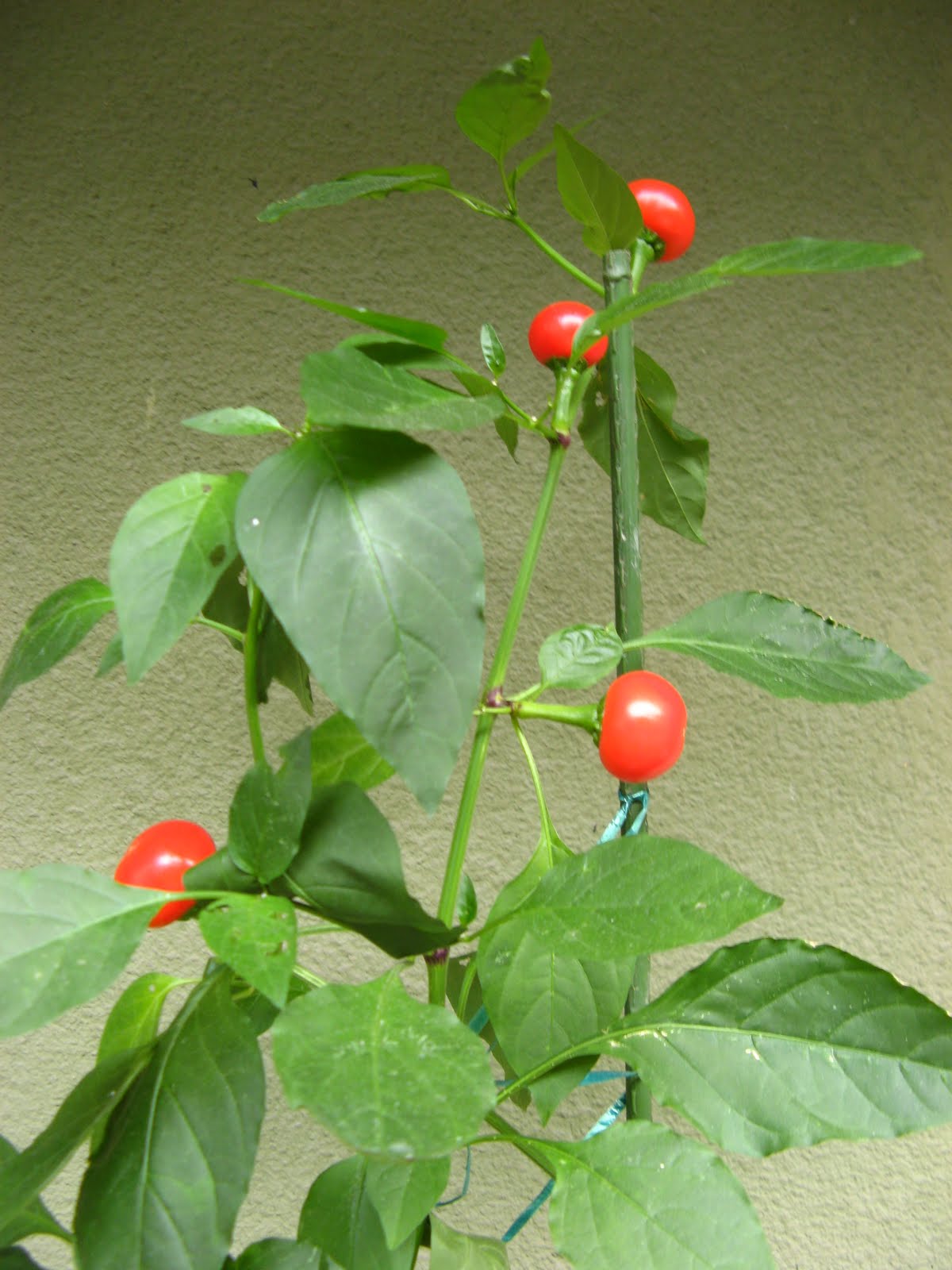

They weren't quite what I expected. I have to admit to having looked too quickly at the label and thought I was buying big, sweet peppers. But when I got home and read it properly - no, they were small, hot peppers.

Now, we don't usually like hot peppers, so I was more interested in them for their ornamental value than anything else. And have they paid off. They've been green and glossy all summer and are now covered in bright red fruit, which looks great against the green walls of the flat.

And unlike virtually everything else I've grown, they've not been touched by sap sucking insects or red spider mite this year. Apart from a bit of caterpillar damage, they're just about the healthiest plants I've got.

Is that because the bugs don't like them? No. These two plants came in a group of four, and the other two went on the front balcony with the tomatoes. And the insects just dived in and munched. They didn't last much past flowering.

So why the difference? The only thing I can point to is this.


Mint, growing at the bottom of the peppers. Or at least, it was.

Back in the summer I wrote a post on companion planting. Some plants will repel insects, thus protecting any other plants growing nearby. Mint is supposed to be one of them.

Now, I ask you - does this look like a plant that has repelled insects? Huh - they've had a feast.

Rather than repelling the insects, it seems to have acted as a sacrificial plant. They've enjoyed the mint so much (and believe me, a while back there was a lot more of it) that they've left the peppers alone.

Well, that's the theory. I can't find confirmation anywhere that mint should attract pests. Every website I've found so far solemnly assures me that insects can't bear it. They've clearly never met ours.

In any case, I know what's going to be growing between all my other plants next year. it's going to be tomatoes and mint, surfinia and mint, roses and mint, hollyhocks and mint, beans and mint, potatoes and mint, honesty and mint, jerusalem artichokes and mint, zinnia and mint, peas and mint, black-eyed Susans and mint, lettuce and mint, morning glory and mint, sunflowers and mint, delphiniums and mint, marigolds and mint, cosmos and mint, calendula and mint, poppies and mint, rosemary and mint, antirrhinums and mint, radishes and mint, alyssum and mint ....

So should you hear people complaining of a mint shortage in North Italy around about the beginning of May 2011, please don't tell ...


Read more...

Companion Planting

Thursday, May 6, 2010


Up to this year, I've always kept my three balconies separate as far as use was concerned. At home the front balcony (the one I look out on and sit on) was for plants in flower, while the back was the herb garden (just outside the kitchen door) and the nursery where I had the seedlings and the cuttings, plus the perennials not currently flowering - chrysanthemums in the spring and summer for instance. Then, my office balcony had a few flowers right in front of the window, but tucked away around the corner (well out of sight of my clients - now why?) was my vegetable garden, with its beans and courgettes and tomatoes.

This year though, I've changed. Nine times out of ten in the past, the veg and the herbs didn't make it - they were decimated by whitefly and red spider mite before they came anywhere near harvest. So this year I've changed tack - I'm companion planting.

The idea behind companion planting is simple. Growing certain plants near others improves the chances of the second group doing well. Why? Several reasons ...

Firstly, some plants will protect others from pests, diseases and environmental factors. So if you pop those in amongst others which are susceptible to those problems, they'll have some degree of protection. So here for example, I've got marigolds next to my tomatoes. Marigolds give off a smell which whitefly can't abide. So in avoiding the marigolds, they'll also have to stay away from the tomatoes. At the same time, I've got peppers planted by the tomatoes. The strong sun hasn't hit here yet this year, but when it does, the tomatoes will shelter them and provide humidity. There's some garlic in there too, as there is around my roses, to repel aphids.


Then there are plants which are supposed to benefit the growth and flavour of others - like basil for tomatoes. That's in there too but it's not quite big enough to see in the photo. A pity that you can't grow mozzarrella - I'd have a complete caprese in one container :)

Some plants will attract beneficial insects. For example, marigolds (yes, they crop up all the time) attract hoverflies , and hoverfly larvae like to munch away on aphids.

And finally, there are the sacrificial plants. This one's sad. You put in something that you know is irresistible to a particular pest, in the hope that it will leave the other plants, which you want to save, alone. There are a couple of nasturtiums tucked in with the roses too to attract aphids.

Why bother? Because every pest that can be deterred with another plant is one that doesn't have to be squirted with some foul, polluting chemical.

It's not all good news of course. Some of the worst pests don't seem to respond to companion planting at all - and, as every summer, my big fear is red spider mite. I've yet to find a plant that will repel it, and all those marigolds are actually going to attract it. And there's always the fear that if you attract them to sacrificial plants, they'll spread. Oh, my poor tomatoes.

And then there are the incompatibles. Just as some plants seem to like being together,and thrive, others seem to hate each other and do badly. Keep your onions away from your peas and beans for example and your tomatoes away from your potatoes. Not always easy if you're gardening in a small space like a balcony.

So what do you grow with what and what should you avoid planting together? You'll find loads of lists on the web - try these Google searches for instance Companion plants and Companion planting. Or if you have a specific plant in mind, just add it to the search box.

But whatever you search for, if you do find a plant that will repel the dreaded RSM, please, please let me know ...


Read more...

A sorry sight ...
Saturday, October 24, 2009


I've always had pelargoniums on the balcony. Common as muck they may be, but in full bloom they're glorious. And with a bit of protection they will not only over-winter, and but also sometimes keep on flowering . If you were reading this blog a few years ago, you'll know that I had one container of salmon-pink zonal pelargoniums that went on for two and half years - in all that time, even in January when it was wrapped up in fleece, there wasn't a moment when it wasn't in bloom.

But each year it got progressively more difficult to keep them alive through the summer. And last year I lost the lot.

So this year I replaced them all. Zonals, ivy-leafed, regals .... Here they are in May this year...


And I've lost the lot again.

Why? Again if you've been reading regularly for a few years, you'll guess. It's this ...


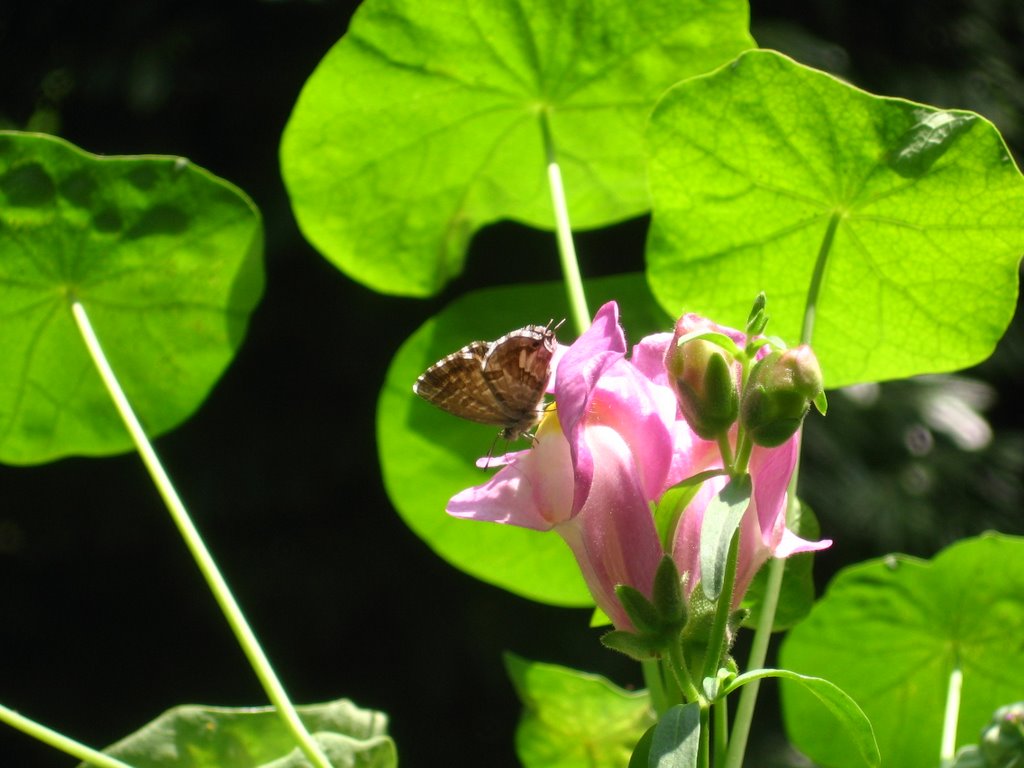
Cacyreus Marshalli, or the Geranium Bronze Butterfly. It's always been a problem, but for the last couple of years it's been impossible to keep the plants alive.

A quick recap for those of you who aren't familiar with it. Native to S.Africa (as are pelargoniums), it was introduced to S. Europe about twenty years ago and has been spreading like wildfire ever since. It's been in Italy since 1996, and is now posing a severe threat to commercial pelargonium cultivation - apart from anything else, because people are starting to avoid buying the plants, knowing they won't survive.

Why does it do so much damage? The larvae of the butterfly don't feed on the leaves. They burrow right into the stems and eat the plant from the inside out, killing it. If you can spot the tell-tale holes you can sometimes cut off the affected part - but over the season you frequently end up cutting back the whole plant.

And go away for a few weeks, like I always have to in the summer (...have to? Only a gardener could feel like that about a holiday ) and you come back to this ...


What can be done about them? There don't seem to be many organic options. One of the studies recommends the "natural" insecticide Bacillus thuringiensis Kurstaki - but don't ask me where I'd get hold of it. (Wonder how many times longer than the bacteria the name is?) There is also an insect with the equally wonderful name of Macrolophus caliginosus Wagner, which feeds off the eggs and hatchling larvae - but ditto, and would it stay on the balcony anyway? Another source suggested companion planting. Highly aromatic plants like lavender, mint and thyme are supposed to discourage the butterfly. Well, I can try - but I have my doubts. By pure chance I did have mint growing fairly near the pelargoniums this year. Not close enough maybe ...

Other than that, it seems there are only two choices - swamp the plants with noxious chemicals, or give up on pelargoniums all together. Don't like the first, and don't want to do the second. But it seems the only other option is to invite yet another massacre ...


Useful Links


Read more...

Yuk - Who ordered that?

Wednesday, May 20, 2009


Yuk. As the physicist Isidor I. Rabi said when they discovered the muon - who ordered that?

The ancient Greeks called it hubris. Overweening pride and arrogance. The sort of arrogance you display by crowing in your last post about how the cool wet spring has kept the pests and diseases at bay. So that even when you go out and find a nasty attack of aphids, you're not phased. The plant's in a small container, so it's easy enough to bring it in and stick it under the tap. No problem.

But then you look at your pelargoniums and find this. Bleah. Where did that come from? And what is it? Rust? Doesn't look quite like the photos on the net. Oh well, not too many leaves affected. Cut them off and see what happens.


And then you walk on and find this. Some sort of leaf miner. They're all over the nasturtiums, and the mallow too. But easy enough to deal with - they're quite visible and you can just scrape them out with your fingernail.


But erm - hold on. What's that sort of yellow mottling on the other leaves of the mallow? They weren't like that yesterday - no way. In fact I was just thinking how green and lush the plant was looking. And what a wonderful shape it was since I cut it back. And how stupendous it was going to look when it bloomed. Hubris. Oh, what hubris.

And at that point you start to panic and look carefully. And in the next container you notice there's a grey webbing all over the hollyhocks ...

And then you panic. Because you know what it is.


Red spider mite.


They've done it again. Two days ago there was no sign. And now half your plants are almost dead. And now you really crack, and start rooting in the cupboard to see if you've got anything foul and chemical left over from last year. Nothing. So you rush out and cut off all the affected leaves, leaving the plants looking shorn and gawky. And spray with garlic solution and cayenne pepper - anything to keep them at bay.

But you know it won't work. Not when they've got to that point.

So the next day you're at the garden centre. You've done your best, but it hasn't worked. You've lasted a few weeks more than last year, but in the end you've cracked again.

And you spray. Again.

Read more...

You still think I'm exaggerating?

Thursday, August 7, 2008


I left them for three days. Just three days. They'd not been doing well. Every time I lifted the leaves hordes of whiteflies would swarm around. They're not a pest that I've ever had before, but then I've never tried growing vegetables either. I didn't want to spray things that I was going to be eating, and found out too late that planting marigolds or nasturtiums with the plants would have helped. But they were bearing up, and I hoped that they might last long enough to give me at least a few courgettes.


And then for three days I couldn't get to my office, where I have my vegetable balcony. The containers are tucked out of sight of the clients. From the office window all you see is some pretty flowers trailing over the balcony railings. but stick your head around the French doors and there they are. Or were.


Just three days. And they hit. Maybe they'd been there before and I'd not noticed, but I went away leaving two relatively healthy looking plants and came back to this.


No, it wasn't just the whitefly, though they clearly weakened the plant. The webbing gives it away.


Red spider mite.


OK, OK we all know I'm obsessed by them. But looking at this, do you really think I'm exaggerating?


Read more...

Clean shaven caterpillars?

Thursday, July 24, 2008


The boys are back. And I was wondering where they'd got to. Whereas by this time of year
the caterpillarium is usually fully inhabited, this year I've not even had to think about it. Until last week that is.

Apart from the dreaded geranium bronze butterfly (cacyreus marshalli) we only really get two types of caterpillar on the balcony, which I suspect are cabbage white larvae. One is the one in the photo above. What is it? The colours are right for the large cabbage white, but it lacks the bristles that all the photos on the net seem to show. We do have a lot of white butterflies around, definitely of the Pieridae family, but the marking isn't quite that of the ones that I've seen illustrated. The other type of caterpillar is green with yellow markings, but doesn't seem to have been around this year at all. Again, it would appear to be very similar to the small Cabbage White, but without the bristles.

Butterflies do, however, exhibit regional variations so I suspect my identifications are correct and its just that Italian caterpillars are clean shaven. Italian men don't go much for beards either, so its obviously a cultural factor.


Anyway, I found the lad in the first photo, plus seven of his brothers and sisters, happily chomping away at an antirrhinum plant. Six are visible in the photo above - can you spot them? In comparison with last year's invasion, when they just about decimated the balcony, this lot are no problem. The plant had finished flowering and I can afford to lose it, so I've left them where they are.

The Geranium Bronze butterfly caterpillar is another matter however. These are definitely not clean shaven but short, squat and bristly. And a sort of odd lozenge shape. But by the time you see them it's too late. The young larva starts life by burrowing into the stems and eating the plant from the inside - see the tell-tale hole?


By the time it emerges as a full grown caterpillar the damage is done. The whole stem has been destroyed.


They're native to South Africa but arrived in Europe twenty years ago and are now widespread over southern Europe, while northern Europe is trying desperately to keep them out. The colder climates in the north may help to stop them spreading, but here they're a plague. I haven't got a plant that's not affected this year. There was an article in the paper the other day saying that geranium sales are down dramatically this year. The article was trying to put it down to the economic recession, but rather contradicted itself by saying that petunias and other annuals are holding their own. I wonder if it isn't just that people are changing away from geraniums because they just get too damaged and tatty. The butterflies are pretty little things, but give me the cabbage whites any day.

Explore some more ...

Cacyreus Marshalli, from the UK Department for the Environment, Food, and Rural Affairs

Read more...

I'm Having Mitemares...

Monday, May 12, 2008


They're back. Punctually. I'd hoped this year would be different. I thought perhaps the cold, wet April which we had would have at least delayed them a bit. But no. Within days of turning the calendar, this is what I found.

Red spider mite.


Two days before there'd been no sign. My mallow, grown from a collected seed pod, was thriving, and I was looking forward to the first flowers. And then I go out to water, and what do I find - yellow, streaky wilting leaves.


Elsewhere, it can be the most idyllic month in the garden. But here in Milan, May onwards is a nightmare of microscopic red monsters sucking the lymph from my plants. I don't mind caterpillars, and I can cope with scale insects, but red spider mite has me waking on hot summer nights in a cold sweat. They are so insidious. You don't see the first few, but two days later there's a colony and your plants are dying, and if you wait any longer, that's it. They can reproduce from 36 hours old, for goodness sake, and will kill a plant in not much longer. This is what happens if you ignore it ...


What can you do about them? First of all, there are preventative measures. Simply misting the plants helps - pay particular attention to the back of the leaves, where the mites congregate. They thrive in hot, dry conditions - just what we have here on the balcony, and which are found in other enclosed spaces, like conservatories and greenhouses - so increasing the humidity helps. Before the infestations hit, I also spray with a mix of garlic, onion, cloves and cayenne pepper - but it doesn't kill off the mites if they do get a hold. Once that happens, the best thing to do is to pick off all the infected leaves, spray with water (or the mixture above) and wipe down the underside of all the remaining leaves. If you live somewhere where you can get them, there is a predatory mite - Phytoseiulus persimilis - which will clear any that you missed. If not, you may have to resort to spraying.

There are organic sprays on the market which you can use. I can't get them here so I can't comment on how effective they are, but I've spent the last month searching for Neem Oil - supposed not to harm bees and other insects - and according to
this article by the RHS, even the chemical companies produce organic sprays.

If you must use a chemical spray, choose one which specifies that it kills the eggs as well as the adults or you're wasting your time. If you combine it with misting and wiping, you should also be able to keep the amount you use to a minimum.


But even chemical sprays will only work if you catch them early. If not, give up. Pull the plant up and throw it away before the rest of the balcony, conservatory or greenhouse is affected too.

I seem to have caught my mallow early enough to save it. It looks a bit straggly where I've pulled off the leaves, but what remains seems green and healthy. And the infestation doesn't seem to have spread to anything else. But I know this is only the beginning. It's going to be a long hot, summer ...

There is of course another remedy, if you're really desperate. Just take the initial s off the word spraying, and possibly you have the only thing that could really work ...

Read more...

A nasty attack of ... what?

Monday, March 31, 2008


The balcony is now starting to turn green again, but not everything is looking happy. I think I may be losing my mandevilla and my hollyhocks.


The mandevilla has been slowly losing leaves all winter, and I hoped it was just a reaction to the cold. I left it outside this year, though well protected. But the leaf loss seems to be speeding up. Leaves start to turn brown, dry and then fall, so that the plant is getting a bare straggly look. A fungus infection? I've tried spraying, but it hasn't helped.


The leaves of the hollyhocks, on the other hand, first wilt and then slowly turn yellowish brown and die. There is also a whitish discolouration on some of the otherwise healthy looking leaves. Another fungus infection? I know hollyhocks are very prone to rust. Or a virus this time?


If anyone recognises the problems (and knows a remedy) please let me know. Otherwise I think I'm going to have to throw them all out.

Read more...

On Bugs ...

Tuesday, January 29, 2008


Does Blogger have a new bug? A while back, when I was working on another of my Blogger sites I suddenly realised the back button on my toolbar wasn't working. I could click on all the links, but could never get back to the previous page. On other sites it was fine - no problems at all. I didn't really have time to think about it at that moment, so mentally filed it away under "to be investigated" and went on to other things.

And then the other day, I realised it had happened to this site too. (Go on - try it. You're trapped ...) So I started to look at other sites, and lo and behold, other Blogger sites were doing the same thing. Carol, May Dreams Gardens seemed to have got the bug - but I've just checked again and it's fine today. Yolanda Elisabet, Bliss in the Netherlands is affected too. But it's not every Blogger site. Some others seem fine.

For a while I wondered if it was my computer. But no, I tried on another and the same thing happened.

Does anyone know what's going on, and how we fix it? It's a b***** nuisance, both when you're trying to work on the site and when you're trying to read it. So if you are stuck here, my apologies. I didn't set the trap, I promise.

Whilst on the subject of bugs, if you read this blog last year you'll know I was plagued by (read obsessed by) caterpillars for much of 2007. How can they eat so much and do so much damage and avoid predators at the same time. So when I found this David Attenborough clip the other day, I couldn't help but watch. The BBC has opened a series of channels on My Space, and are inviting people to post them to their own sites. So, The Balcony Garden brings you (legally) David Attenborough and the sneakiest caterpillar in the world. The amazing thing is the complexity of the programming that must exist in the miniscule blob of protoplasm that makes up the brain of this tiny creature ...


PS - but an important one : Remember the Garden Blogger's 2008 Carnival? You're still in time to show your appreciation of one of the blogs which you enjoy by nominating it for next week's carnival. It's a great way to say thank you. Click on the link for details.


Read more...

They're Back!

Saturday, September 29, 2007


Two extremely busy weeks at work have meant no blog posts and a very neglected balcony. I'd rushed out a few times after dark to water, but apart from that hadn't really looked at anything in daylight for a fortnight. And so hadn't realised that the caterpillars were back ...


I've said before that they were bad this year, but I'd hoped that the worst was over. yet in the past couple of weeks they seem to have come back with a vengeance. Half my plants look like lace doilies, several have been completely stripped of leaves, and this poor hollyhock has just given up the fight.


Even worse though is the mess - both balconies were completely covered in caterpillar droppings. If you have a garden, you probably don't realise how much a couple of teensie caterpillars excrete, but on a balcony they just plop onto the floor and stay there. Here's hoping that next year they won't be quite so bad .


Read more...

Slugs, Snails and Sex

Wednesday, September 12, 2007


What's the difference between a balcony garden and a garden garden? The number of pests and diseases you notice. They're probably all there in the garden, but with such a large number of plants, the majority are liable to survive. In the London garden this year I only really had three problems.

The first was predictable - blackspot on the roses. I spray every time I'm there, but it's never enough. The second was a surprise - one of the cotoneasters half dead from red spider mite or something. But it was a big plant and after I'd cut back the three quarters that was badly affected, hosed it down and then sprayed, it bounced back with no problems.

The third was something you don't get on a balcony - slugs and snails. I've always liked snails and when I was a small child, used to keep them as pets in a cage. (I was horrified one day to find them all joined together in pairs. Having failed to pull them apart, I rushed screaming into the house to tell my mother, who reassured me that they were "just playing". And lo and behold, the next day they were all back to normal). I can often find two or three hundred or more in the garden over a two or three week period. Most of the time they're welcome, as they do the work of keeping down the weeds that the tenants usually don't, but once I've finished clearing the garden, and start to plant out seedlings, they become a nuisance. So I do a snail hunt, stick them all in a bucket and transfer them to the wildest part of the park behind the house - which is also the most remote from any other gardens.

Slugs though have always been a different matter. There was something about them that turned my stomach and I could hardly bear to pick them up, even with gardening gloves, to put them in the bucket. Imagine then the horror when I didn't realise that one had fallen into one of my gloves - until I started poking around in the fingers to find out what the squishy thing was.


This year though, there were so many in the garden - a lot more than usual and much bigger than usual, that I started to get interested. And by the end of the holiday was a convert. I'd not realised before how beautiful they can be.

So when I got home to my books and the internet, I started to do some research. It's difficult to be sure at a distance and I wish I'd taken more photos, but I think most of the ones in my garden were, like the one in the photo, the orange variety of the large black slug.

I also saw some Leopard slugs though - and if you really need convincing that slugs can be beautiful, have a look at this video of leopard slugs mating from the BBC. The Karma Sutra pales by comparison.


Read more...

Invasion of the toxic caterpillars

Friday, June 1, 2007

I've mentioned before that I've been having problems with caterpillars this year, and it's been getting worse and worse. We always have some, but nothing like this year. I've been going out every day to pick them off, and I've still lost about a third of my plants. For the first time ever red spider mite has paled into insignificance in comparison.

So I was interested today to come across a videoed news report on the BBC site about an invasion of toxic caterpillars in Belgium. It's such a plague that they're having to mobilise the army to deal with them. I can't link directly to the video, but click here and it will take you to the right page to find it (see the right hand sidebar).

Read more...

Cacyreus marshalli ... and company

Wednesday, May 16, 2007

May is the month the pests come back, and I've already had my first run-in with red spider mite. I think I won, but it's only the first battle in a war which will go on till the autumn, so I'm now checking daily and spraying regularly as a preventative measure with a mixture of onion, garlic, cloves and cayenne pepper which I found on a site called Bonsai Garden.

Other pests are also rampant and my caterpillarium now has a large number of residents chomping away. Unfortunately, I haven't always been able to move them in on time. I was in Tuscany for a couple of days last week and came back to find one of my chrysanthemums in an extremely sorry state - half eaten by voracious green caterpillars, and the other half infested by blackfly.

But the most worrying thing this year is the enormous number of geranium bronze butterfly (cacyreus marshalli) caterpillars that I've found. This is a pest that is rare so far in the UK and one that you're supposed to report officially if you see it - you can see photos and get details on the site for the Department for Environment, Food and Rural Affairs. But it transferred to southern Europe from Africa some years back, and in Italy is now well established. Not surprising, as it can go through 5 or 6 generations a year. It attacks pelargoniums, and though the mature caterpillars feed on the leaves and flowers and so are easy to spot and pick off, by then the damage has been done. There's an earlier stage where the newly hatched larvae bury into the stems and tunnel down through the plant, and that's what really does the damage. So there's no way of confining this one to the caterpillarium.

Acknowledgement :
Photo of the geranium bronze butterfly provided under Creative Commons Licence by zigari44 via flickr


Read more...

Virus Attack

Saturday, September 2, 2006


After four months of blooms, the hollyhocks are still going strong and, although the stems are getting a bit straggly, I haven’t the heart to pull them out yet. I’m going to have to though as one has got what appears to be mosaic virus (see below). I’m a bit worried about it – I can destroy the plant and change the soil in the container, but the container itself is a large stone pot which is far too heavy to move or tip up. So disinfecting it would be a big problem. I can’t just pour in disinfectant as it would run straight out of the drainage holes – and straight onto the balcony below. But I’d like to grow more hollyhocks in the same place next year and I’m worried that the virus will just be passed straight on. I've already got a lot of young plants coming on, but sadly, my favourite purply red flowers didn't produce seeds. I don't know why. It bloomed as well as the others, though a bit later, but just didn't produce seed pods.

My pelargoniums also seem to be having problems. I noticed this problem of leaf colour (photo below) a few weeks ago. I thought it was a nutrition deficiency problem, so changed the top layer of soil and fed the plant fairly generously. But now it’s appeared in a second pot and I’m wondering whether it too isn’t a virus. I really hope not, because it’s attacked a huge plant which I’d be very loathe to lose, and which I was about to take cuttings from. Does anyone recognise it?

Read more...

Before and After

Sunday, August 27, 2006

The one thing you can’t do if you’ve got a balcony garden is go away and leave it unattended in summer, and expect it to look the same when you get back. Even a short holiday of ten days, like I’ve just had, is asking for trouble. I have the same problem every year – first of all I don’t know anyone here who really enjoys gardening, and would take it on for me, and – even if I did – as everyone goes on holiday at more or less the same time in Italy, they’d probably be away too.

So I have to rely on a very uninterested plant-sitter to water for me, and just forget about the possibilities of pests and diseases. And I know what I will find when I get back – pots saturated and standing in three inches of water, and plants either drowned completely or so weakened that they’re easy targets for anything that wants to eat them. I swear every year that I’m going to invest in an automatic watering system and next year I really must get round to it ….

This year, as I was only away for a relatively short time, it wasn’t too bad. The worst hit were the marigolds. If you look back to August 9 you can see what they were like when I left. This is what I came back to ….

The Revenge of the Red Spider Mite. Obviously I’ve had to yank out and throw away the ones that were this bad, but I’m hoping that about 50% will make it. I’ve cut off the worst-affected lower parts and will spray the rest. But this morning there were so many butterflies on the balcony that I couldn’t. Here’s one on one of the antirrhinums. Does anyone know what type it is? Its caterpillars are small and green.

And a lot of butterflies obviously means a lot of caterpillars. I’ve lost several plants with others looking decidedly tattered, but nothing that isn’t duplicated elsewhere on the balcony. I shall do a caterpillar hunt later and move them out of harm's way before I start to spray.

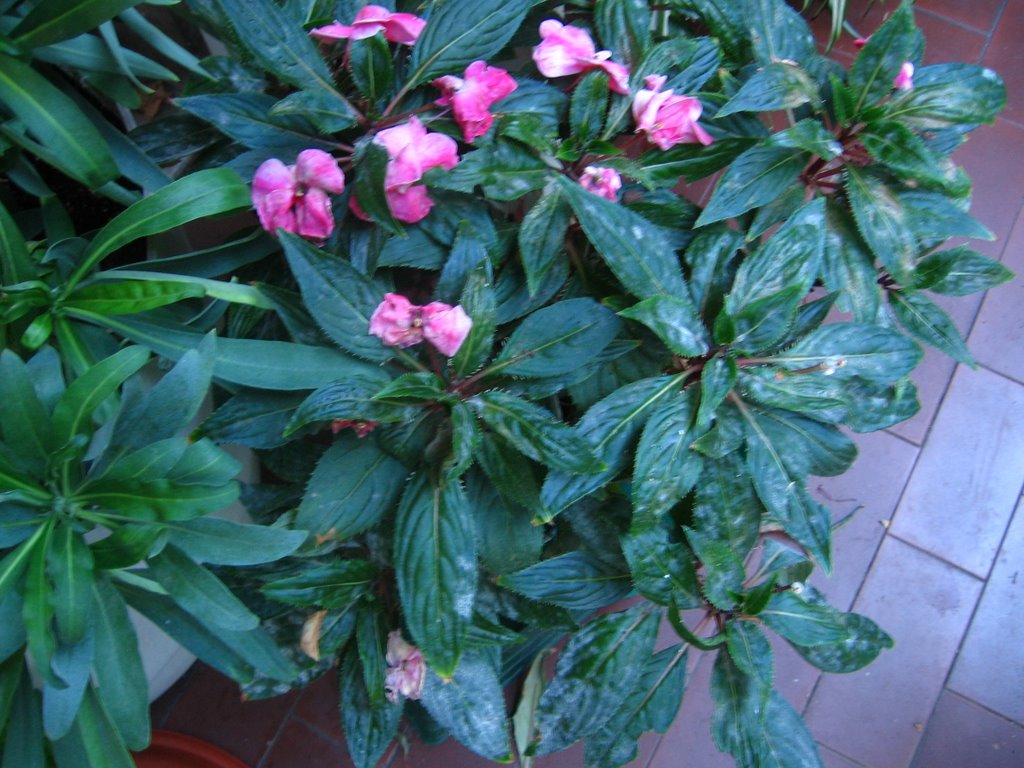
Another casualty has been my New Guinea Impatiens. The photo on the right was taken shortly before the holiday ….
...and this is what it looked like yesterday.
It’s been hit by powdery mildew. I washed as much of it off as possible by spraying with milk and then wiping the leaves clean. And then resprayed the whole plant. We shall see. If it doesn’t work I may have to resort to a chemical fungicide.

Before I left, I’d sprayed one of my begonias with milk to try and ward off rust. Unfortunately I can’t tell you if it worked as it’s succumbed to over-enthusiastic watering and the stems have rotted away. I’m sure I’ll get another chance to try it out before long though.

I’ve also lost a number of seedlings through damping off, though the ones which were already well established are doing well. And talking of seedlings, the ones in the photo in the last post were, in the centre antirrhinum, and then going from one o’clock in a clockwise direction : foxglove, lychnis, hollyhock, bellis, forget-me-not, honesty and stock.

The final plant, at twelve o’clock, is the mystery plant. I suspect it’s a type of erigeron, though it’s not like the ones you normally see in gardening books. I got the seeds from a plant growing in a rockery garden. It produces a thick, almost woody stem and trails along the ground or over the rocks. And produces a profusion of daisy type flowers with pink petals and a large yellow centre. It was in a position that got very little rain, so obviously likes dry conditions. You couldn’t see it very well in the last picture so here’s another one. Any ideas??

Read more...

On Pests and Diseases

Sunday, August 6, 2006


I would love to be able to say that I’m a 100% organic gardener, but I can’t. I did try last year, but 2/3 of the way through the summer when I’d lost everything to red spider mite I gave up and drenched the whole balcony in insecticide. In order not to have to do that again, this year I’ve tried a sort of combination approach. I’m using organic remedies wherever possible for prevention, but at the first sign of real trouble use a limited amount of insecticide or fungicide and then go back to the organic remedies. It’s worked well so far – I’ve used relatively little in the way of chemicals, but have lost almost nothing. I would love to cut down still more though, so if you have any organic remedies which really work, let me know. One advantage of balcony gardening is that you can forget about pests like slugs and snails, but anything that can fly or is carried in the air still manages to arrive. Some of the problems I’ve had this summer are :

Rust : at the moment I’ve got a nasty attack on my begonias. I’ve picked off the leaves with the worst problems and I’m now spraying with milk. Apparently it’s an excellent fungicide and deals with various diseases, including rust. But it seems to be mainly recommended for powdery mildew, so I’m trying it on my calendulas too as they often get badly affected.


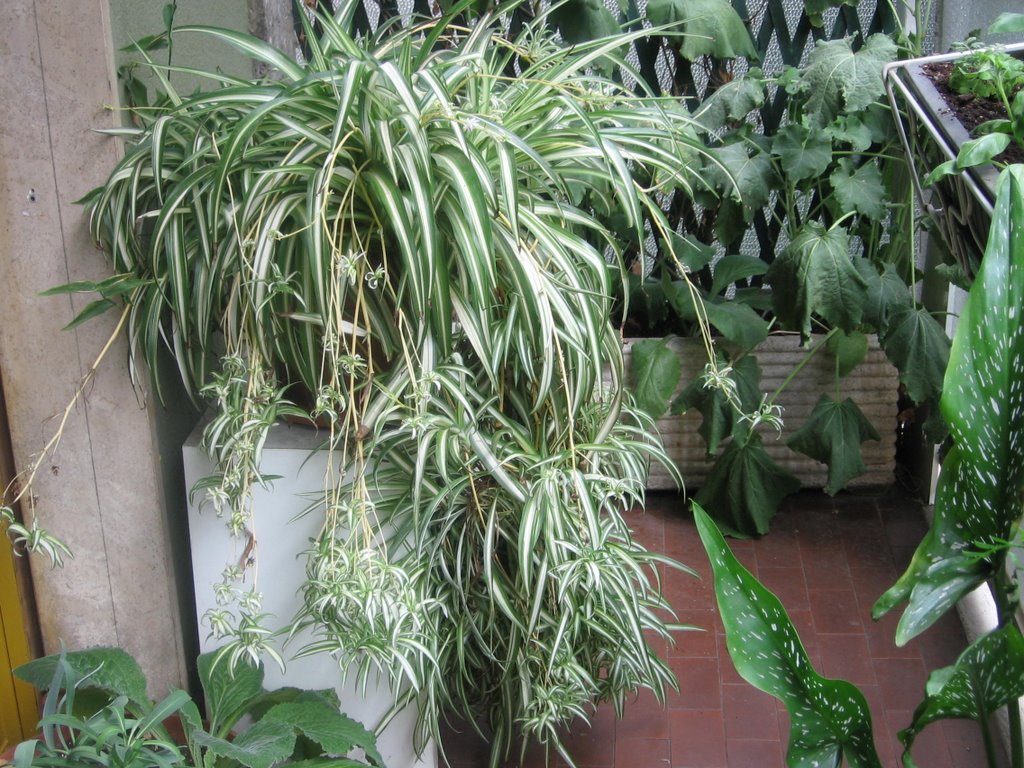
Caterpillars : these are a regular problem in the late summer. The type we mostly have come from a small brown moth and are green and “loopy”. I pick them off by hand and take them down into our courtyard and let them go on the rather weedy lawn. The idea is to avoid killing them, but I suspect I’m really just feeding the birds. When my son was little, we did have a "caterpillarium" one year. I planted some small spider plants in one those big containers which are used to store kids toys, covered it with foil wrap (with breathing holes) and transferred all the caterpillars we found to their new home. We then watched them as they ate, grew, pupated and turned into moths. It was fun, and as I always have thousands of baby spider plants growing on my "adults" (photo above), meant I lost nothing that couldn't be easily replaced.

Red Spider Mite : these are the bane of my existence and from April onwards take up most of my gardening time and energy. Last year I tried a garlic based spray, but it didn’t work, possibly because I waited too long before I started using it. It also meant that the whole balcony stank of garlic. This year I started looking for the beasts very early, and either picked off the leaves or, when I found just one or two, simply sprayed the undersides of the leaf with water and wiped the mites off. I then went on spraying all the plants that I thought might be at risk either with the garlic solution or just with water. With plants in smaller pots I simply upended them and stuck them under the kitchen tap. Except in a couple of cases it’s worked, and I’ve only had to use the chemical spray a couple of times for plants which I’d missed and where the mites had really taken hold. The chemical spray has been necessary though. My son was trying to grow runner beans, which we haven’t sprayed chemically at all, but despite all the water spraying and lots of tender loving care, they’ve ended up in a very sorry state.

Aphids : these have only been a minor problem this year. At one point I found a lot on my Mandevilla (photo right), but luckily the same day I found a ladybird wandering around the balcony - unusual, as they're not very common here. I transferred her to the Mandevilla and that solved the problem. But other years I’ve sprayed them with an oily mixture – it's supposed to clog the pores they breathe through.

Read more...

  © Blogger templates Newspaper by Ourblogtemplates.com 2008

Back to TOP