Powered by Blogger.
Showing posts with label Chrysanthemums. Show all posts

The Chrysanthemum Experiment - Results

Monday, November 29, 2010


This year I've been experimenting with my chrysanthemums. I have some little yellow ones which I've been growing for years now. Every year I leave the old plants till early spring, and then take cuttings from the new growth. That's what all the books tell you to do, saying that the old plants will never produce such good blooms in subsequent years. Was it true? This year I decided to try it out.


If you click here, you'll find the posts I wrote in March (when I took the cuttings) and May (when they'd taken and it was time to "stop" all them in order to convince them to put out side shoots). But I've reproduced the photos to show you the main stages. I took cuttings, but didn't throw the old plants away. Instead I planted the cuttings in the same container, in between the older ones.


Why? well firstly to fill the gaps left by a couple that had died over the winter. But also to ensure that the soil, water, light and fertiliser conditions were identical for both sets of plants. As any primary school child will tell you, an experiment is only a "fair test" if one variable, and one only had been changed. In this case the variable was old plants vs cuttings. Everything else was identical.

Back in May, the new plants looked pretty puny in comparison with the old. But by the time autumn arrived, I could only remember which was which by going back to the spring photos to check.


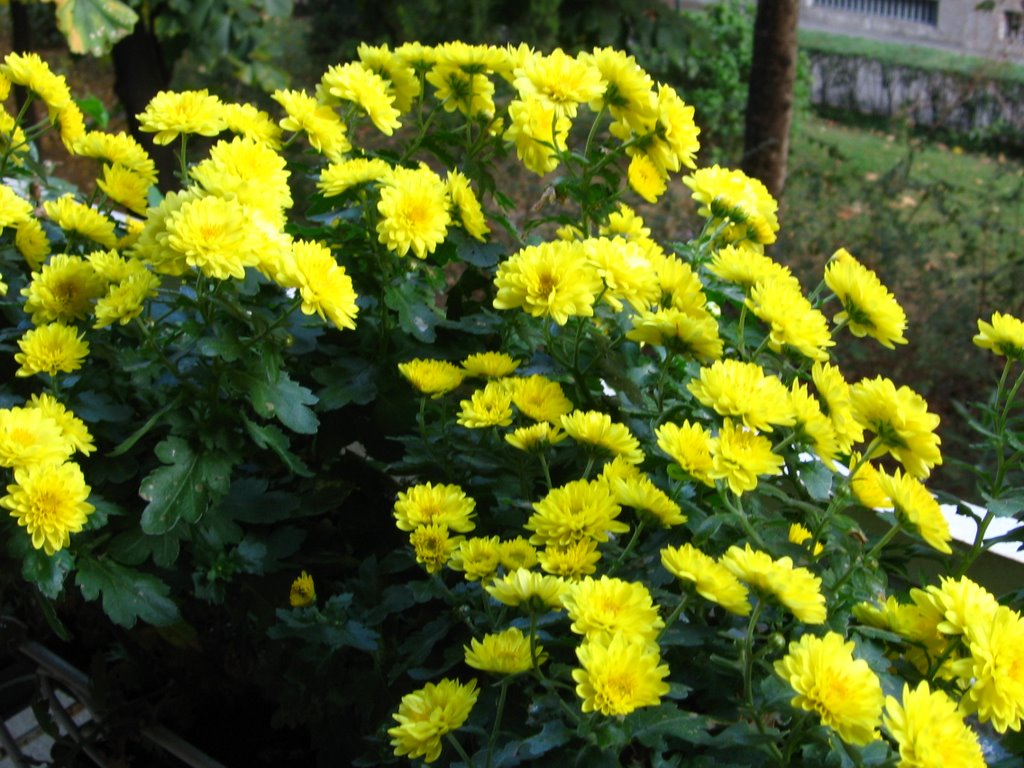
By October they were covered in buds. Whichever won, it was going to be a good year. And, when the buds opened, it was immediately clear that...


... there was no difference at all. Both sets of plants are full of flowers, the flowers are all of the same size, and I can see no difference of any kind.

So will I be taking cuttings next year? Yes, certainly. But to increase the number of plants I have, not to replace the old ones. From now on, my chrysanths can go on for as long as they feel like it...

Read more...

It's time to stop ...

Sunday, May 23, 2010


... your chrysanthemums.

Back in March I talked about the chrysanthemum cuttings I'd taken, and how I wanted to see whether, as all the books told me, cuttings planted anew would give a better show than if I just left them on the plant. Here they were back then - three cuttings sheltered between the two mother plants.


And here they are now.


So far no contest. In terms of growth the old plants are far outstripping the babies. But of course there's plenty of time yet before they flower. So far the new plants must have been putting most of their energy into developing roots. So we still need to wait and see...

They do need attention though. As you can see from this one in an individual pot, what growth there has been is all upward.


Now if you want large, single blooms, that's fine. But if you'd prefer a mass of smaller ones, then you need to "stop" the plant - that is, pinch out the central growing tip so that side shoots will form and, eventually, flower.

If you really get into it, stopping is an art form all of its own. Should it be done once or twice? When exactly? How many side shoots should be encouraged to develop? It depends where you live, what you want the blooms for, even what cultivar you've got. Have a look at this site for an idea, but believe me - whole books have been written on the subject.

Luckily, unless you're trying to produce blooms for show purposes, you can be much more cavalier about it. I stop mine once when they get to about six inches in height, some time in May, and then let them get on with it. And the actual pinching out is easy. See the new little leaves growing at the top of the stem ?


Gone ....


And come November, they'll be bursting with blooms.


Read more...

Chrysanthemum cuttings ... or not?

Sunday, March 21, 2010


All the gardening books are adamant - Chrysanthemums will do better if you start afresh with new cuttings each year than if you just let the old plants sprout again.

I've always been very obedient. Over the winter the old plants die down, but by spring, shoots are - well, shooting up from the base. And I always pull them off to use them as cuttings.

This isn't intended to be a how-to post, but just in case anyone is interested, it's dead easy. You need shoots at least two inches long. Pull them off gently, then cut the stem straight across just below a leaf node. Again gently, pinch off the lower leaves, leaving just a couple at the top. Pop them into some damp potting compost and - well, just wait. They may look a bit floppy at first, but one day (a month or so later) you'll suddenly notice that they've perked up - and you'll know they've rooted.


There are variations on a theme of course. You could try dipping them in hormone rooting powder before planting them. But I never have, (I can't get the stuff locally)and four out of five have always made it - just plant more than you need. Or you can cover them in a propagator - but I'm getting ahead of my story.

We've had an exceptionally cold winter. Lots of my plants haven't made it and, for the first time, that includes my chrysanthemums. Last autumn I had five plants in this container, all taken from cuttings the previous spring ...


... by this spring only two had survived, and another plant (top photo) was looking extremely sorry for itself.


Now, by rights, I should have stripped all three plants of their new shoots and potted them all up to create new plants. But the bad weather has meant putting it off, and off, and off. Up to ten days ago, night-time temperatures were still below zero - not the best time to take cuttings.

I'm one of those people who, though having enormous respect for the experience of experts, does like to see things for myself. It's not that I don't believe them - I just want to try it out. So I thought that this year I might try an experiment. For the large white variety which was half dead, I've salvaged two cuttings and thrown the mother plant away. But for the little yellow variety, I've mainly left them as they are, only taking enough cuttings to fill the gaps left by the ones that died this winter. Three cuttings have gone into the spaces around the two survivors and I've got a couple more in pots in case those three don't make it. Will the gardening books be right ? In the autumn we'll see which are producing the best blooms - the old plants or the new cuttings.


I'm giving the cuttings a bit more help than usual this year though - by covering them to create a more humid, and warmer atmosphere. I've never bothered before, but with the long, cold winter having delayed everything, I reckon they need all the help they can get. The DIY "propagators" are just cut-off mineral water bottle bottoms. They can either be pushed into the soil around the plant (if it's already in its growing position), or fitted over small pots.


Read more...

Don't throw those chrysanthemums away - well, not yet anyway...

Saturday, November 7, 2009


Chrysanthemums have to be THE plant of the late autumn. Just when everything else is dying off, they burst into flower and - depending on what type you've got and how they've been treated - will treat you to a mass of small blooms or wow you with a smaller number of much larger ones. Not to mention a range of colours from reddy brown through yellow to creamy white - and even pink and purple, colours which are less common here. And all the different petal shapes ...

Where does the name come from? In 1753 Karl Linnaeus, the Swedish botanist who first started to classify plants and animals logically, combined the Greek word chrysos, meaning gold, with anthemon, meaning flower. And despite
attempts by recent taxonomists to change the plant's classification, the name has stuck.

In Italy the shops start to fill up with chrysanths in early October. Forget lilies, here chrysanthemums are the flower of the dead - the plant you take to the graves of your loved ones on November 1st. Buy them at the beginning of the month and they're cheap. By Hallowe'en the price has quadrupled.

Being the flower of the dead, it's not a flower that most people have on their balconies here. But I wouldn't be without mine. Especially my little yellow ones. I've had them for years and they go on and on and on ... If you've bought a pot of chrysanths for your balcony this year, don't even think of throwing them away after they've stopped flowering.

They do need a bit of care though. First of all, cut of the dead flower heads as soon as - well, as soon as they're dead. If you're in a fairly cold zone, they'll need covering. We have a Hardiness Zone 8 type climate - the temperature may drop well below freezing in January. Mine get moved back towards the walls of the house and covered in fleece. And don't overwater during the winter.

By March you'll notice that new shoots are starting to come up from near the base of the old plant. These are what you want for next autumn's blooms. Take them off the plant when they're about 2.5 ins long, remove the bottom two leaves and cut vertically across the stem just below the leaf joint. Dip the end in hormone rooting powder and pop them into some potting mix in a propagator to root. Keep them in a warm place.


Well, that's what the books say. But quite honestly I find it works just as well without the hormone rooting powder and with ordinary potting soil. And I don't usually bother with a propagator - quite often I'll put them straight into the pots where I want them to grow. But then, it can be quite warm here in March. But anyway, they're one of the easiest plants to root from cuttings that I know. You may lose a few this way (so take more than you expect to need), but most will be quite happy.

And then you can throw the old plant away. You could try keeping it, but the results aren't usually as good as the first year.

Once the cuttings have rooted, keep in mind that chrysanths like soil which is rich in organic matter and neither very acid nor very alkaline. You'll also need to decide whether or not to "stop" them in April. "Stopping" means pinching out the growing shoot of the plant to encourage it to put out side shoots. If you stop, you'll end up with a myriad of small flowers, If you don't, you'll get a tall stem and one, much larger flower. As you can see from the photos, I stop ...


I have a sneaking affection for these little yellow ones. Yes, I've tried others and I'm the first to admit that these aren't half as elegant as many of the larger ones . I've got some large white ones in bud which I hope will flower soon, and a couple of years ago I had some nice red-brown ones. But nothing does quite so well as these do. They don't seem to mind the heat we have all summer, they shrug off pest attacks, and don't complain at all when they're left to the hideous over-watering that my plant-sitters inflict on them when I'm away. I don't care if the neighbours do think I'm weird - my chrysanths are here to stay.


Read more...

All Saints Day

Thursday, November 1, 2007


Today is All Saints' Day, in Italy the day of the dead. It's the day that everyone visits the cemeteries to take flowers to the graves of relatives who have died. The flower of death here is the chrysanthemums (never give an Italian chrysanthemums as a present!) and by now the cemeteries will be awash with chrysanths of all shapes and sizes.

I have only in-laws to visit here, and they had mostly died before I knew them. I've lost my own parents and grandparents, and that leaves a sense of loss far beyond the two years it is "supposed" to take to get over a bereavement. But, however deep the loss, when older generations die there is a sense of naturalness and inevitability about it which is quite different to the shock of the death of someone younger. This afternoon I started thinking about two friends of mine who died when they were only in their early thirties, both of whom had changed my life in ways they probably never imagined. Their deaths hit me very, very hard. Tom, David - this post and these chrysanthemums are for you.


Read more...

Chrysanthemums

Monday, November 13, 2006


Over two weeks since I posted - I've been swamped with work. The Indian summer didn't last long - a few days after I wrote the temperature suddenly dropped to ten degrees, and everything on the balcony went into shock. Not so much due to the temperature itself, as to the overnight change. Luckily we had forewarning, and I brought in the last of the more delicate plants. Around about the same time there was a really interesting post on Hanna's blog explaining exactly why some plants are more susceptible to cold than others. It had never occurred to me to think about why plants didn't like the cold before.

The temperature has now gone up a bit to around about 12° daytime temperatures and everything has got over the initial shock and settled down. My chrysanthemums are now in full bloom, and I used one of the big white ones to take the scanner photo below. The idea is not original - it comes from an artist called Katinka Mason. My personal favourite is her White Calla Lily. But when I tried, I was amazed how easy it was. You just lay the flower on the scanner and leave the top open while you scan. I use them for desktop wallpaper as you can use the black space for your icons.


I managed to grab a bit more sun last week though as I had to go to Casablanca for work. More about that in the next post ...


Read more...

  © Blogger templates Newspaper by Ourblogtemplates.com 2008

Back to TOP